AbsoTech — technology in the Absolute group: the same path to mastery, only in technologyAll of Absolute
Build a request
S-01 · Science frontiersPilots

Brain–computer interface

An implant reads brain signals and turns them into cursor movement or text.

—medical trials
a service, not a product
TRL 6
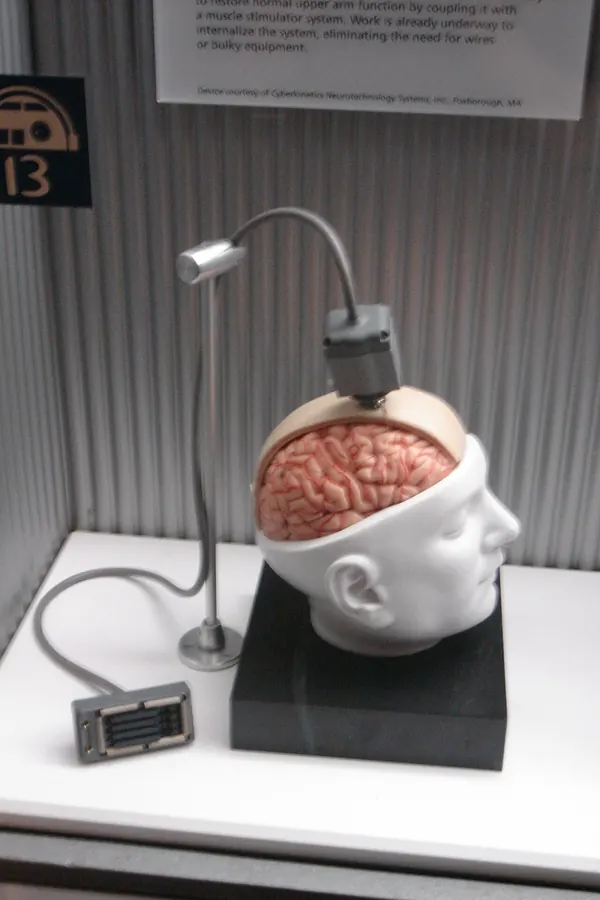
Display model of the BrainGate implant
In the photo: Display model of the BrainGate implantPhoto: PaulWicks at English Wikipedia · Public domain · Wikimedia Commons

A brain–computer interface reads the electrical signals of neurons and turns them into actions: cursor movement, letters on the screen, commands for devices. For people with paralysis it means getting back a voice and independence: writing a message, opening email, controlling a computer by thought. Today this is medicine and clinical trials; in March 2026, China approved the first implantable interface for people with spinal cord injuries.

How it works

Every movement starts in the brain. When a person is about to move a hand, neurons in the motor cortex send short electrical impulses — spikes. Even if the signal does not reach the muscles because of a spinal cord injury, the pattern of activity in the cortex remains: the brain keeps giving commands. The interface connects right here — at the point where the intention already exists but the path to the hand is cut.

Thin electrodes — flexible threads or a tiny grid — are placed next to neurons, and each one hears the nearest cells, like a microphone in a noisy hall. The signals are amplified, digitized and sent wirelessly to a computer. There a decoder runs — a machine learning model. The person imagines movements, and the model learns which pattern means what: “up”, “left”, “click”. After this calibration the cursor goes where the person wants.

Newer systems decode not only movements but also attempted speech: the model recognizes the sounds and words a person is trying to say and assembles them into text. There are options that do not require opening the skull — a sensor inside a blood vessel or a cap with EEG electrodes — but the signal through bone is weaker and coarser. The main questions today are how long electrodes last in the body, decoder accuracy and the safety of the surgery.

Where it already works

  • People with paralysis: typing text and controlling a computer by thought.
  • China: in March 2026, the first implantable interface for spinal cord injury was approved.
  • Neuralink’s clinical trials — 21 participants as of January 2026.
  • Research on speech interfaces: an attempt to say a word becomes text on the screen.

What to consider

  • This is medicine: access is only through clinical trials and regulator-approved programs.
  • An implant requires brain surgery — doctors make the decision together with the patient.
  • Store-bought EEG headsets read the brain coarsely — that is not the same as an implant.
  • Neural data is the most personal data there is: ask where it is stored and who sees it.
A joke on the topic

Humanity’s dream: to control a computer by thought. The computer’s dream: for thoughts to arrive one at a time now and then, not as a whole crowd.

Autocorrect used to fix what I typed. I am afraid to imagine how it will fix what I think.

At last, “I was just thinking that” becomes verifiable: simply open the decoder log.

Nearby on the radar

Full radar
A-01 · AILive

AI agents for hours of work

A model in a loop with tools: it plans, acts, checks the result and fixes mistakes on its own.

From $0.14 to $30 per million tokensfrom the open DeepSeek V4-Flash to the flagships, 2026
TRL 8
RU with caveatsVN can be brought in
How it works

The agent gets a task in words, opens a terminal, a browser and files, takes a step, looks at what came out and moves on. That is how one instruction turns into hours of programming, data analysis or document review.

Fact. By METR’s measurements, the best models of 2026 succeed half the time on tasks as long as an expert’s working day.

Russia. Western cloud models are unavailable in Russia — GigaChat, YandexGPT and open models on your own server work.

Sources: METR: task horizon · DeepSeek V4 prices

All about the technology: photos, video, details
A-02 · AILive

Your own AI on your own server

The open models DeepSeek and Qwen run inside the company: data does not leave.

Server — per taskthe model is free; you pay for hardware and deployment
TRL 9
RU can be brought inVN can be brought in
How it works

The model weights are downloaded and run on a GPU server in your own server room. The model reads documents, answers employees, sorts through mail and contracts — and sends nothing to someone else’s cloud.

Fact. DeepSeek V4 (24 Apr 2026) — 1.6 trillion parameters and an open MIT license; it trails the flagships by 3–6 months, by DeepSeek’s own estimate.

Russia. A strong option for Russia: data stays inside the country and the company.

Source: DeepSeek V4

All about the technology: photos, video, details
A-03 · AIPilots

AI at the computer

The model looks at the screen and presses the buttons itself — like a person at a PC, in any program.

With a model subscriptionplus setup for the company’s processes
TRL 7
RU with caveatsVN can be brought in
How it works

The agent receives screenshots, works out where a field, button or menu is, and sends clicks and keystrokes. It already does short tasks in office software reliably; long ones — not yet.

Fact. In the OSWorld 2.0 test, on tasks longer than 300 steps, the best agent succeeds 20.6% of the time.

Source: OSWorld: agents and humans

All about the technology: photos, video, details
Have a task? Build a request

Two minutes — country, task, budget and timing. That is enough to propose a solution.