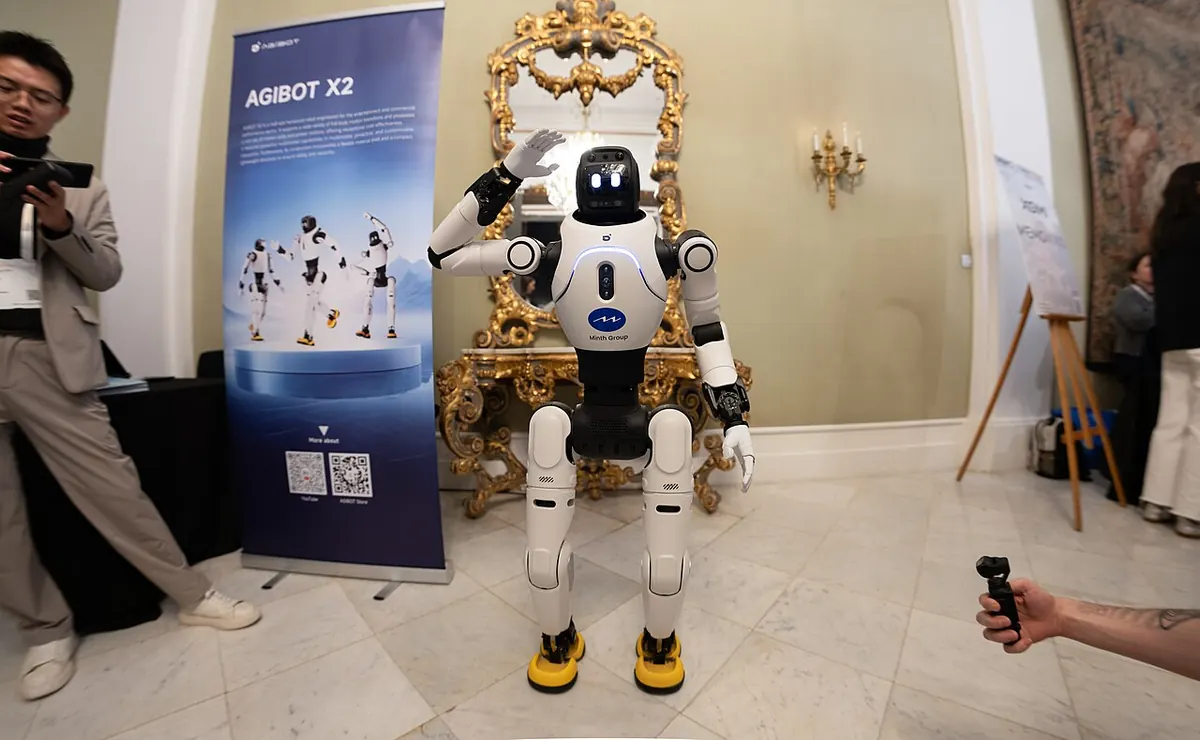
AgiBot (Zhiyuan) is China’s leader in humanoid shipments in the first half of 2026. The company makes not one robot but a family: wheeled models with arms for warehouses and stores, and two-legged ones for interacting with people. For business, this means choosing the form for the task rather than for a picture from the movies — and robots that already work in retail.
How it works
The wheeled AgiBot robot is a torso with two arms on a mobile base. Wheels spend no energy on balance, so the charge lasts longer, and the body stands steady even when the arms reach for the top shelf or lift a box. For a warehouse or a store with a flat floor, this form is simpler and more reliable than legs: fewer joints to keep under control.
Two-legged models are for places where the robot meets people: at the entrance, on the sales floor, at an exhibition. They walk, gesture and talk, while cameras and microphones catch who has come up and what they asked. The robot’s voice and face are the interface for the shopper, and behind them can sit the store’s database: the product range, promotions and the route to the right shelf.
AgiBot’s main bet is its own “brain”: models that turn camera images into arm movements. Such models learn from many repetitions: an operator controls the robot by hand, the system records what the cameras saw and how the joints moved, and the neural network gradually finds the link between image and action. The more recordings, the more confidently the robot picks up unfamiliar objects.
Where it already works
- ASDA, UK — 100 AgiBot robots work as customer advisers in the chain’s supermarkets
- Warehouses and stores — AgiBot makes wheeled models with arms for them
- Entrances, sales floors and exhibitions — two-legged robots greet people and answer questions
- Hanoi — AgiBot showed its robots at the GSMA Digital Nation Summit in 2026
What to consider
- The A2 Lite costs $44,560 at the manufacturer’s price — add delivery, taxes and launch on top
- To Russia — without official distributors and with payment difficulties: build a margin into the timeline and budget
- Check which languages the robot understands and answers in — for a sales floor, this is the deciding question
- The robot is strong in the scenario it was set up for: order a new task as a separate project