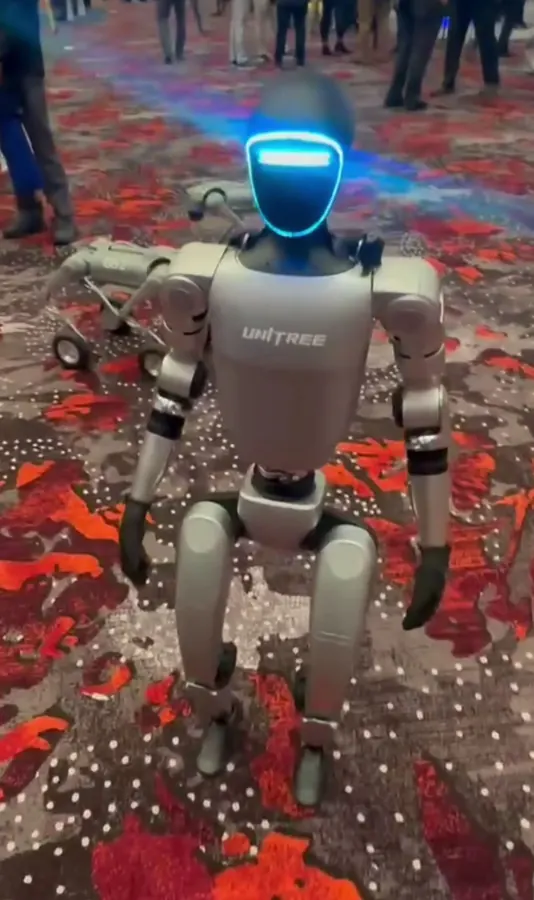
Unitree humanoids are the most affordable production humanoid robots: the R1 costs from $4,900, the G1 from $13,500, the H2 $29,900. The G1 has become the main platform for universities, labs and shows around the world. For business, it is a way to start with humanoids today: train the team, run pilots and draw crowds at exhibitions without waiting for such robots to get even cheaper.
How it works
Inside are electric motors in every joint: hips, knees, ankles, shoulders and elbows. A motor with a compact gearbox both turns the joint and senses the load through its current, so the robot sets its foot down softly and absorbs the jolt of each step. The G1 is about 1.3 m tall: tall enough to work at a table and a shelf, and short enough for the body to stay light and run off a battery in the torso.
To keep its balance, the robot polls a gyroscope and an accelerometer hundreds of times a second — the same sensors as in a phone, only more precise. Cameras and a depth sensor show what is ahead: a step, a box, a person. The controller brings all of this together and, every fraction of a second, decides anew where to put its foot and how to shift its body so as not to fall.
The robot learns to walk in simulation: thousands of virtual copies fall, get up and try again until the neural network finds a stable gait. Dances and gestures are transferred from a human — the movements are recorded on an actor and recalculated for the robot’s joints. The rest is a programmer’s job: through the developer toolkit, they set what to pick up, where to carry it and how to behave around people. Out of the box, the G1 is a platform, not a ready-made worker.
Where it already works
- Universities and labs — the G1 as a platform for courses, research and competitions
- Shows, exhibitions and events — dances and performances that draw people around a brand
- Heineken Vietnam and an engineering university are teaching the G1 to handle boxes at the brewery in Vung Tau
- Manufacturing — a humanoid pilot on one operation: carrying boxes, feeding parts, inspection rounds
What to consider
- Out of the box it is a platform: a programmer assigns the useful work — budget your team’s time for scenarios
- The prices are official but exclude taxes and delivery; the R1 ships from the end of 2026
- There is no official distributor in Russia — settle warranty and spare parts before you pay
- The EDU versions contain an American NVIDIA module — for Russia, a check against sanctions rules is required