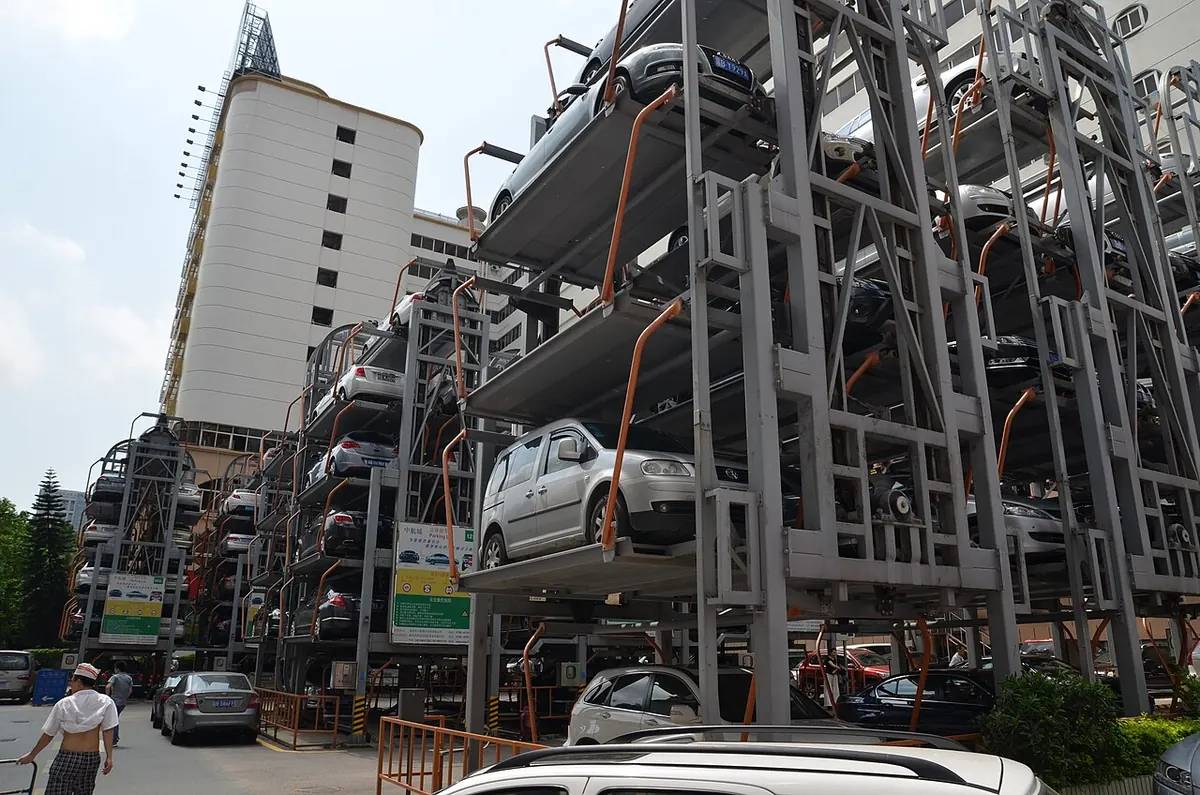
Automated parking is a warehouse for cars. The driver leaves the car in a bay at the entrance, and lifts and shuttles put it into a cell on their own and bring it back on request. Without ramps and driving lanes, more spaces fit on the same plot, and the developer gets a parking garage instead of an extra underground level. In Moscow, such systems work in 14 luxury residential complexes.
How it works
There are three main layouts. “Puzzle”: platforms on several tiers slide sideways and rise, clearing the way for the right car, like tiles in a sliding-tile puzzle. Tower: a lift in the center and cells on the sides — the car rises to its floor and moves sideways onto a shelf. Car silo: a shuttle runs on rails along long rows and puts the platform into any free cell.
The entry bay is the only place where the system meets a person. Sensors check the car’s dimensions and weight, light barriers make sure no one is left in the bay, and cameras record the drop-off. The driver gets out and confirms it with a card or in the app — and from then on, people do not enter the storage area. That is why inside there is no need for walkways, bright lights or room to open doors: cars stand more densely.
Everything is run by a controller with a database of cells: it knows where every car is and plans the platform moves in advance. In many systems, you call your car from the app ahead of time — by the time you arrive, it is waiting in the bay. A smart system can pull cars closer to the exit in the morning and spread them out to the far cells in the evening. Retrieval time depends on the layout and the load, so it is calculated at the design stage together with the number of entry bays.
Where it already works
- Moscow’s luxury residential complexes — 14 projects and over 1,200 spaces.
- Housing and office developers: a parking garage instead of an extra underground level.
- City centers, where land is expensive and spaces are scarce.
- Hanoi: official parking covers only 8–10% of demand in the center.
- Hotels, hospitals and parking operators in dense urban areas.
What to consider
- The system is planned at the building design stage: fitting it into an existing basement is hard and expensive.
- Work out the peak hour and the dimensions: how many cars leave in the morning, and whether tall SUVs fit.
- You need a service contract and backup power: without them, no car comes out during a power cut.
- In Vietnam, the main barrier is fire-safety approval under the QCVN codes (Vietnam’s national technical regulations): build it into the schedule.