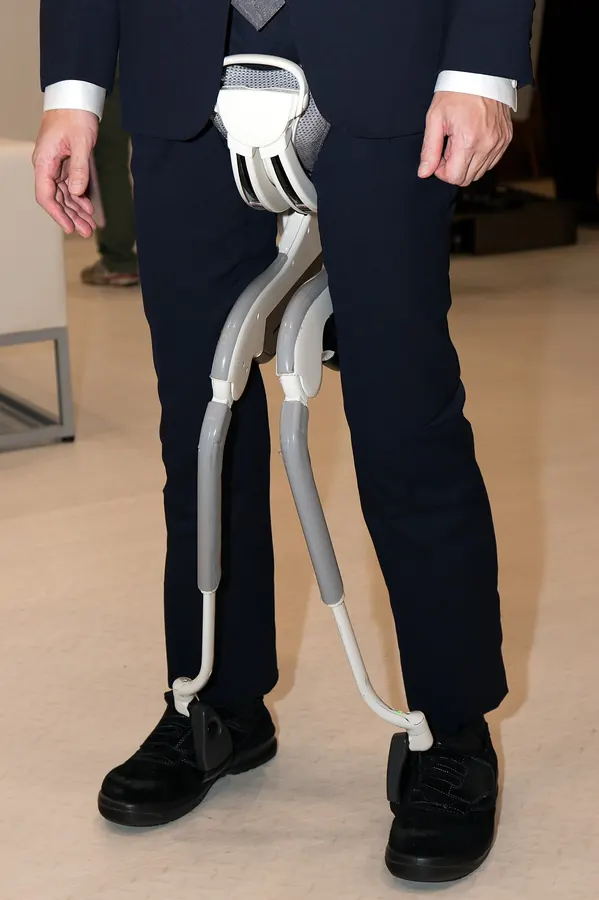
A hiking exoskeleton is a belt with a motor and light struts with cuffs around the thighs. Hypershell X takes on part of the effort of every step uphill and on stairs, so a long climb comes easier and you still have strength left in the evening. You buckle it on over ordinary clothes and take it off when the trail levels out. It is not a medical device but gear — like trekking poles, only with a battery.
How it works
The exoskeleton has motion sensors that work on the same principle as the ones in a phone: accelerometers and gyroscopes. Many times a second they report how the thigh is angled and how fast it is moving. From this picture, the algorithm works out the phase of the stride — the leg swings forward, takes the weight, pushes the body up — and recognizes what is underfoot: a flat road, a climb, stairs or a descent.
A motor with a gearbox sits at the hip joint, and a rigid strut transfers its force to the cuff on the thigh. At the moment the leg pushes the body up, the motor adds torque and extends the hip together with the muscles. On flat ground it barely steps in, so as not to throw off your usual stride. It feels as if every step has become a little lower and the backpack a little lighter.
Power comes from a battery on the belt, and how fast it drains depends on the route: the longer and higher the climb, the faster the charge runs down. In the app you choose a mode and how strongly the motor pushes each step. Exoskeletons of this class can also have a reverse mode for training: the motor does not ease the step but loads it. On a long route, you plan the charge the same way as water and food.
Where it already works
- Mountain hikes and trekking with long climbs.
- City stairs, hilly streets and buildings without elevators.
- Walking tours and all-day outings with a backpack.
- Trips where you need strength left in the evening for the way back.
What to consider
- The exoskeleton makes each step easier, but it does not replace training, footwear and knowing the route.
- The charge is finite: check the battery before a long climb.
- Check how the belt and cuffs sit over your hiking clothes — everything depends on the fit.
- This is gear, not a medical device: if you have joint problems, see a doctor first.