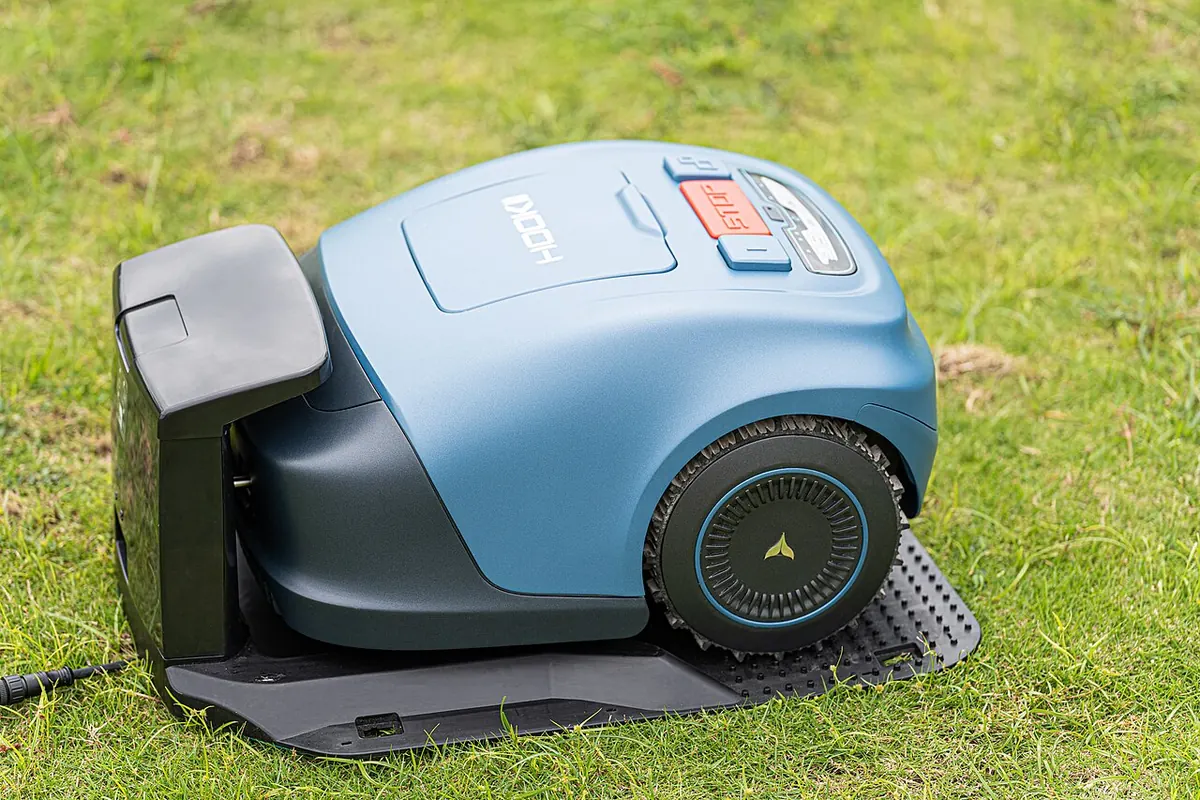
A wire-free robot lawn mower mows by satellite: nobody buries a cable around the edge of the plot or repairs it after the gardener’s spade. Segway Navimow and Mammotion LUBA keep to boundaries with an accuracy of a couple of centimeters, mow on schedule and drive back to charge on their own. The lawn stays just as neat all summer, and your weekends stay free for rest.
How it works
Ordinary GPS in a phone is off by several meters — on a lawn, that already puts you in the neighbor’s vegetable patch. RTK corrects the error: a base antenna is set up on the plot; it stays still, sees the same satellites and constantly sends the robot corrections. The mower’s receiver subtracts the shared error and knows its position to within a couple of centimeters — enough to run in straight lanes and stay off the flower bed.
Boundaries are set in the app: you drive the robot around the perimeter once from your phone, like a remote-control car, or draw the outline with a finger on the map. Flower beds, paths and no-go zones are marked separately. Cameras at the front watch the way ahead: a neural network recognizes a ball, a garden hose, people and animals, and steers around them. Under dense tree cover, where few satellites are visible, some models hold their course using the cameras.
Most of these mowers have a cutting disc with small blades: it spins fast and cuts a little at a time, while the robot goes out on the lawn often and trims only the tips of the grass. The fine clippings fall back and become fertilizer, so no grass bag is needed. Tilt and lift sensors stop the blade within a fraction of a second if the robot is lifted or turned over. When the charge runs out, the mower drives to its station and then carries on from the same spot.
Where it already works
- Private houses and dachas, where there is no one to mow by hand or no time to.
- Complex plots with flower beds, paths and several lawn zones.
- Hotels and villas, where the lawn is kept even every day.
- Plots where the boundary wire keeps getting cut by spades, roots and moles.
What to consider
- It needs open sky: under dense tree cover and near tall walls, the satellite signal weakens.
- Check what area and slope the model is rated for: the Navimow line runs from $1,099 to $4,499.
- The base antenna goes up high with a clear view of the sky — plan its spot and power in advance.
- At night the lawn belongs to the hedgehogs: better to schedule mowing for daylight hours.