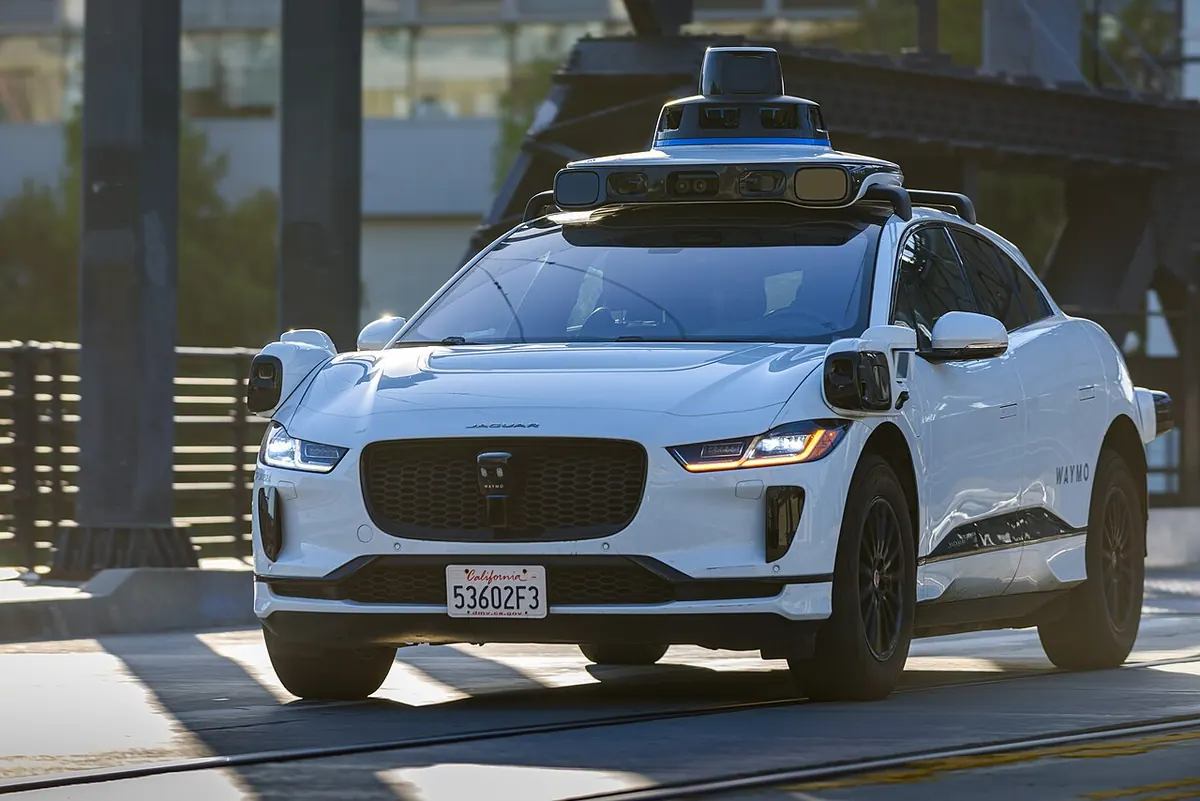
A robotaxi is a car that carries paying passengers with no driver at the wheel. You call it in an app, get in the back seat, and the steering wheel turns by itself. In the US, China and the Middle East it is already everyday life: Waymo makes over 500,000 paid rides a week. For a city it is transport without fatigue or shift changes; for business, a new logistics of moving people.
How it works
The car sees the world three ways at once. A lidar sends out millions of laser pulses a second and, from the time they take to return, builds a three-dimensional point cloud — the shape of every car, curb and pedestrian. Radars measure distance and speed and see through rain and fog. Cameras read the color of traffic lights, lane markings and signs. The data merges into a single 360° picture, and matching it against a detailed map of the area gives the car its position to within centimeters.
Then a neural network takes over. It does not just see a cyclist — it predicts where the cyclist will go in one second, two, five, and does so for everyone around at once. A planner runs through possible movements and picks the one where everyone is safe and the passenger is comfortable: no jerks or hard braking. Every tricky situation on the street becomes data: it is replayed thousands of times in simulation, and the whole fleet learns from one car’s experience.
An L4 robotaxi drives without a driver within its own zone and conditions — in areas the company has studied and mapped. If a situation is unclear, such as an unusual street closure, the car stops and asks a remote operator. The person suggests a solution — “go around on the left” — but does not steer: the car performs the maneuver itself. In this setup the person is a consultant, not a driver.
Where it already works
- Waymo — over 500,000 paid rides a week in 10+ US cities.
- Baidu Apollo Go — 28 cities and an expansion into Dubai.
- WeRide operates in Abu Dhabi together with Uber.
- Russia: Yandex carries passengers in Sirius (near Sochi) and Innopolis (Tatarstan), and in Moscow — employees, with a test operator on board.
- Vietnam: Hanoi is running pilots of driverless buses and robotaxis.
What to consider
- This is a service, not a product: you cannot buy the car; you can work with it through a partnership with an operator.
- The service runs only within its own zone and conditions — check the area boundaries and the weather.
- In Russia and Vietnam the service is so far limited to pilot zones — it is too early to build logistics on it.
- For business, the closer fit is next door: over 1,000 Yandex rovers already deliver orders.