AbsoTech — technology in the Absolute group: the same path to mastery, only in technologyAll of Absolute
Build a request
E-02 · EnergyLive

Industrial battery storage (BESS)

Battery containers for factories, hotels and grids: they shave peaks, hold a reserve and store cheap energy.

Per projectdepends on capacity and use case
RU can be brought inVN can be brought in
TRL 9
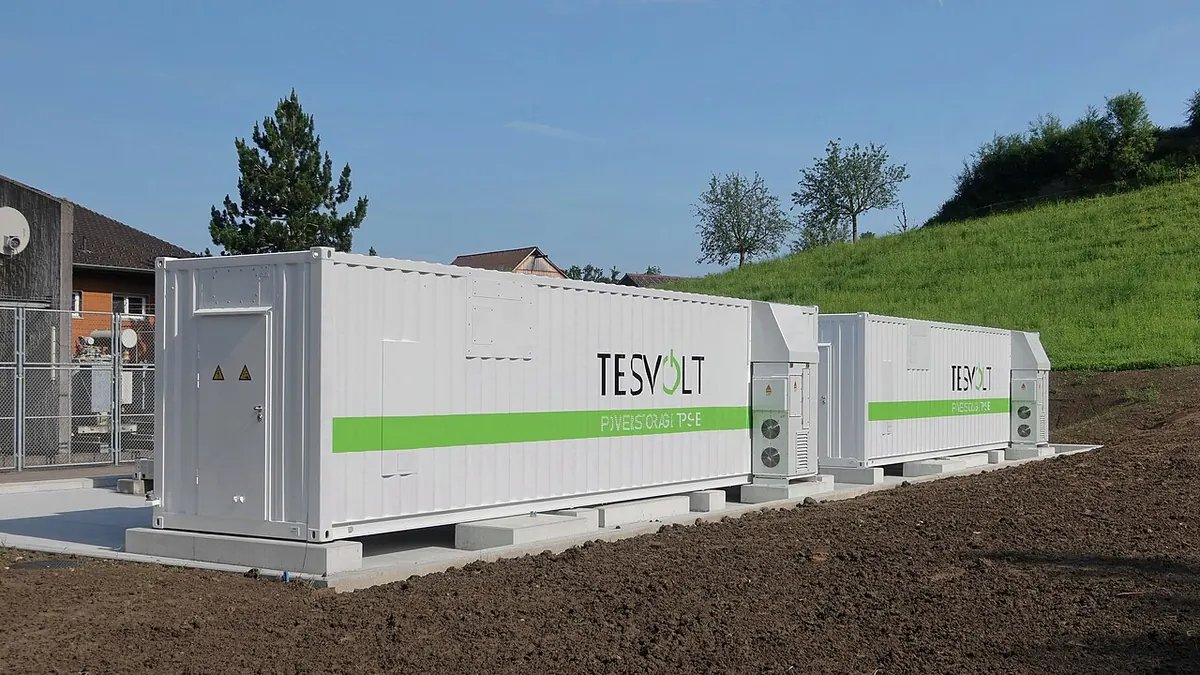
Tesvolt container battery storage in Rheineck, Switzerland
In the photo: Tesvolt container battery storage in Rheineck, SwitzerlandPhoto: Kecko from Eastern Switzerland · CC BY 2.0 · Wikimedia Commons

Industrial battery storage is a container with batteries, its own electronics and its own climate inside. It stores energy when it is cheap or when the sun is shining and releases it at peak hours or during an outage. For a factory, hotel or grid, that means shaved load peaks, backup without a diesel generator and the ability to keep until evening everything the solar plant produced during the day.

How it works

Inside the container are racks of modules; each module holds dozens of LFP cells, thousands in total. The cells are connected in series and in parallel to get the required voltage and capacity. The BMS sees each one: it measures voltage and temperature and balances the charge so that no cell is overloaded before its neighbors. Alongside are liquid cooling or air conditioners, gas sensors and fire suppression: the battery likes a narrow temperature range, and the climate in the container is held more precisely than in an office.

Batteries deliver direct current, while the factory and the grid run on alternating current. Between them stands a bidirectional power conversion system, the PCS: when charging it rectifies the current, when discharging it turns it back into alternating current, exactly in step with the grid. The brain of the system is the EMS software. It sees the tariff, the load schedule and the solar output forecast and decides when to store and when to release. At night energy is cheaper — the battery charges; in the morning the machines start up — the storage takes the peak on itself.

For the grid, storage is the fastest player: it goes from charging to discharging in a fraction of a second, faster than any turbine. That is why grids install batteries to hold frequency, smooth out swings in solar and wind output and cover the evening gap, when the panels go dark and people come home. At a plant, the same system works as backup for an entire workshop: if the circuit is designed that way, the line keeps running during a grid failure.

Where it already works

  • Factories and warehouses: peak shaving and backup in case of outages.
  • Hotels and resorts: solar by day, storage in the evening, air conditioning without interruptions.
  • Power grids: in 2025, 112 GW of storage was deployed worldwide, 54% of it in China.
  • Vietnam: the power development plan calls for 10–16.3 GW of storage by 2030.
  • EV charging hubs where the grid cannot handle the peak power.

What to consider

  • Fire safety means certified LFP cells, proper installation and a design with fire suppression.
  • The tariff decides payback: work out the difference between cheap and expensive hours from your own bills.
  • Capacity and power are different things: how much energy is stored and how fast it can be released.
  • In Vietnam the rules for storage are still being written: the Ministry of Industry and Trade is preparing a BESS policy.
A joke on the topic

Battery storage is the perfect trader: it buys energy at night, sells at the peak, drinks no coffee and has never once asked for a bonus.

“What’s in this container?” “Yesterday’s sunshine.” “Got any fresh?” “Fresh is on the roof. This one’s aged, for the evening peak.”

If the lights in the workshop flicker and the machines do not even notice, the container in the yard has once again reacted faster than the chief power engineer.

Nearby on the radar

Full radar
E-01 · EnergyLive

Solar and battery for the home

Rooftop panels plus an LFP battery: lights and air conditioning even when the grid is down.

Vietnam: 5 kW — 44–48 million VNDgrid-tied plant without a battery, installer price 2026; with a battery — more
TRL 9
RU can be brought inVN can be brought in
How it works

By day the panels power the home and charge the battery, and a hybrid inverter decides where to draw energy from. In the evening the home runs on the battery, and the surplus goes to the grid — where that is allowed and paid for.

Fact. Chinese TOPCon panels cost about $0.11 per watt ex-factory — cheaper than ever.

Russia. The best fit: the south, dachas without a reliable grid, and backup in case of outages.

Vietnam. Since 26 Jun 2026 (Decree 243), rooftop surplus can be sold — up to 50% of output, including from a battery.

Sources: Decree 243/2026 · TOPCon prices, Jul 2026 · Vietnam installer prices

All about the technology: photos, video, details
E-03 · EnergyPilots

Sodium-ion batteries

Batteries made with sodium instead of lithium: cheaper raw materials and almost no fear of frost.

So far in cars and storage systemsfew retail modules
TRL 8
RU with caveatsVN with caveats
How it works

Sodium comes from ordinary salt, and there is thousands of times more of it than lithium. CATL Naxtra holds 175 Wh per kg and keeps over 90% of its capacity at −40 °C — for a Russian winter, that is the deciding argument.

Fact. The first production car on sodium — Changan Nevo A06 (February 2026).

Source: CnEVPost, 05.02.2026

All about the technology: photos, video, details
E-04 · EnergyAnnounced

Solid-state batteries

The liquid electrolyte is replaced with a solid one: more range, faster charging, lower fire risk.

—no series product
TRL 6
RU not yetVN not yet
How it works

A solid electrolyte allows a lithium anode and denser energy packing. The difficulty is manufacturing: the layers must be perfect, or the cell degrades.

Fact. Toyota is aiming for 2027–2028, Samsung SDI for 2027; buyers do not have such cells yet.

Source: Battery Design: timelines

All about the technology: photos, video, details

Where to get it

Selection and delivery of industrial battery storage systems on request across Russia: Moscow, Saint Petersburg, Sochi, Krasnaya Polyana, Krasnodar, Yekaterinburg, Kazan, Novosibirsk, Nizhny Novgorod, Rostov-on-Don, Samara, Ufa, Krasnoyarsk, Perm, Voronezh, Chelyabinsk, Tyumen, Vladivostok, Kaliningrad and other cities.

Selection and delivery of industrial battery storage systems on request in Vietnam: Hanoi, Ho Chi Minh City, Da Nang, Nha Trang, Phu Quoc, Hai Phong, Bac Ninh.

Have a task? Build a request

Two minutes — country, task, budget and timing. That is enough to propose a solution.