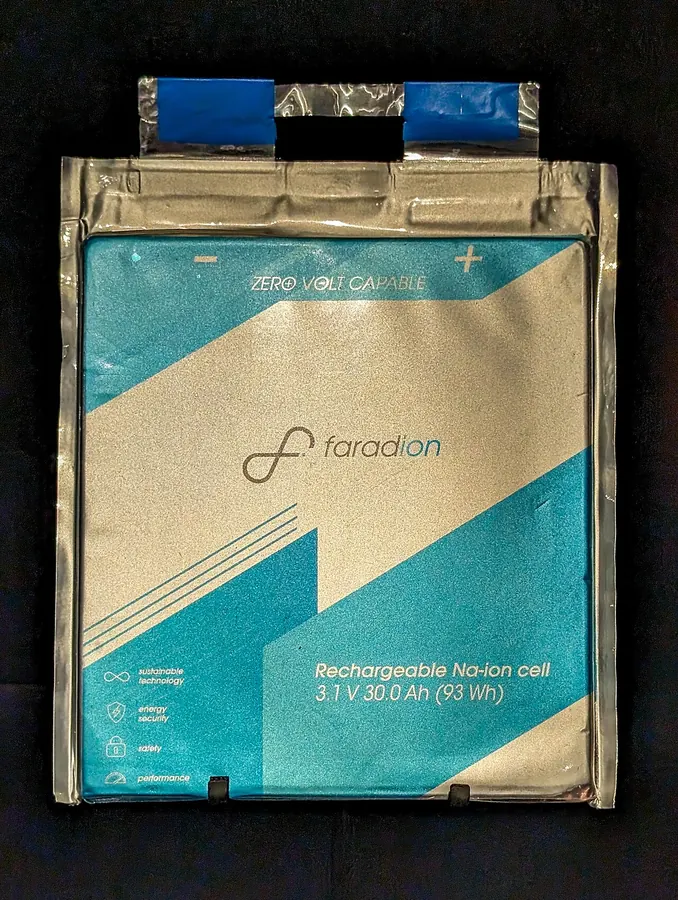
A sodium-ion battery is built like a lithium one, only with sodium instead of lithium — the element found in ordinary salt. The raw materials are cheaper and easier to get, and in frost such a battery loses much less capacity. For cold regions, storage systems and cars, that argument outweighs record density: a battery that delivers energy at −40 °C is worth more than one that is only good in summer.
How it works
Inside is the same “rocking chair” principle as in a lithium battery: two electrodes and an electrolyte between them. When charging, sodium ions leave the cathode and hide in the anode; when discharging they return, and meanwhile electrons travel through the external circuit and do work — spin a motor or light a lamp. Sodium and lithium sit in the same column of the periodic table and their chemistry is similar, so the cells can be made on similar equipment.
The difference is size. A sodium ion is larger than a lithium ion and fits poorly between the layers of graphite, so the anode is made of hard carbon — a porous material with cavities the large ion enters freely. The cathode is layered oxides or compounds with a Prussian blue structure. Also, sodium does not alloy with aluminum, so the current collector on both electrodes is made of light, cheap aluminum foil instead of copper.
In the cold, any battery is sluggish: the electrolyte thickens and the ions barely move. A sodium ion clings less tightly to the solvent molecules and sheds this “fur coat” more easily on entering the electrode, so the battery delivers energy even in hard frost. CATL Naxtra holds 175 Wh per kg and keeps over 90% of its capacity at −40 °C. The price for this is density: the best lithium cells still store more energy per kilogram.
Where it already works
- Production cars: the Changan Nevo A06 with a CATL sodium battery — since February 2026.
- Energy storage, where weight does not matter but raw material cost and frost do.
- Cold regions: the battery keeps over 90% of its capacity at −40 °C.
- Looking ahead: backup for telecom and outdoor equipment, where lithium weakens in winter.
What to consider
- There are few retail modules so far: sodium today is a project built for a task, not a box off the shelf.
- Density is lower than in the best lithium cells: for long trips, lithium is still stronger.
- Ask who makes the cells and what warranty they carry: the technology is young, and suppliers are few.
- Import into Russia and Vietnam is complicated and is settled per project.