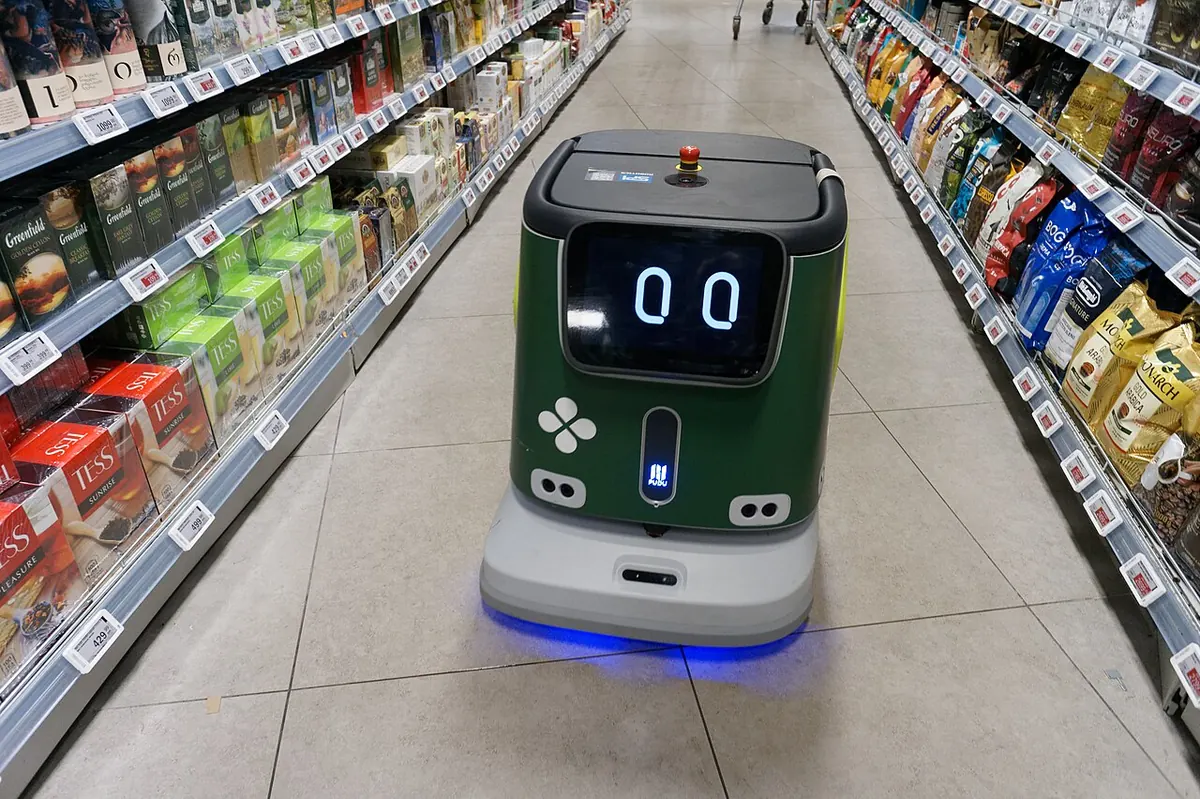
Cleaning robots — Pudu CC1, Gausium, Keenon C40 — scrub and vacuum malls, airports, offices and factories. This is the most widespread class of service robots: cleaning brings in over 70% of Pudu’s revenue. For business, it means a clean floor on schedule, including at night, with a report on every cleaning run, while people move to work that needs eyes and hands.
How it works
First, the robot drives through the building once with an operator and memorizes the map: the lidar measures distances to walls and columns, while cameras and floor-level sensors see obstacles and the edges of steps. Zones and a schedule are marked on the map. After that, the robot picks its own route, drives in straight lanes without gaps and steers around people, carts and advertising stands.
Underneath, the robot has brushes, tanks for clean and dirty water, and a rubber squeegee with a vacuum that picks up the water behind it. So the floor behind it is dry at once, and people can walk on it. Many models both vacuum and scrub: the mode changes by zone on the map — carpet in the lobby, tile in the gallery, concrete on the shop floor.
When the battery or the water runs low, the robot drives to its station on its own — charges, drains the dirty water and takes on clean — and then goes back to work. One person watches several robots from a phone: where each one is, what has already been cleaned and where a robot is calling for a person to step in. A report on every cleaning run stays in the system — with a map and the time.
Where it already works
- Malls, airports, offices and factories — scrubbing and vacuuming large areas
- Russia: the Lenta supermarket chain works with 42 cleaning robots
- Hotels and resorts — cleaning lobbies and corridors at night, with no guests around
- Vietnam — no large-scale deployments in malls and airports in sight yet; the space is open
What to consider
- Russia: buying — ₽2–3.5 million, rental — from ₽100,000 a month, and it pays back against a cleaner’s salary of ₽90,000 and up
- The station needs water, a drain and a socket — find a spot for it before buying
- The robot takes the open areas; corners, stairs and small rooms stay with people
- Wages in Vietnam are lower than in Russia — calculate payback separately