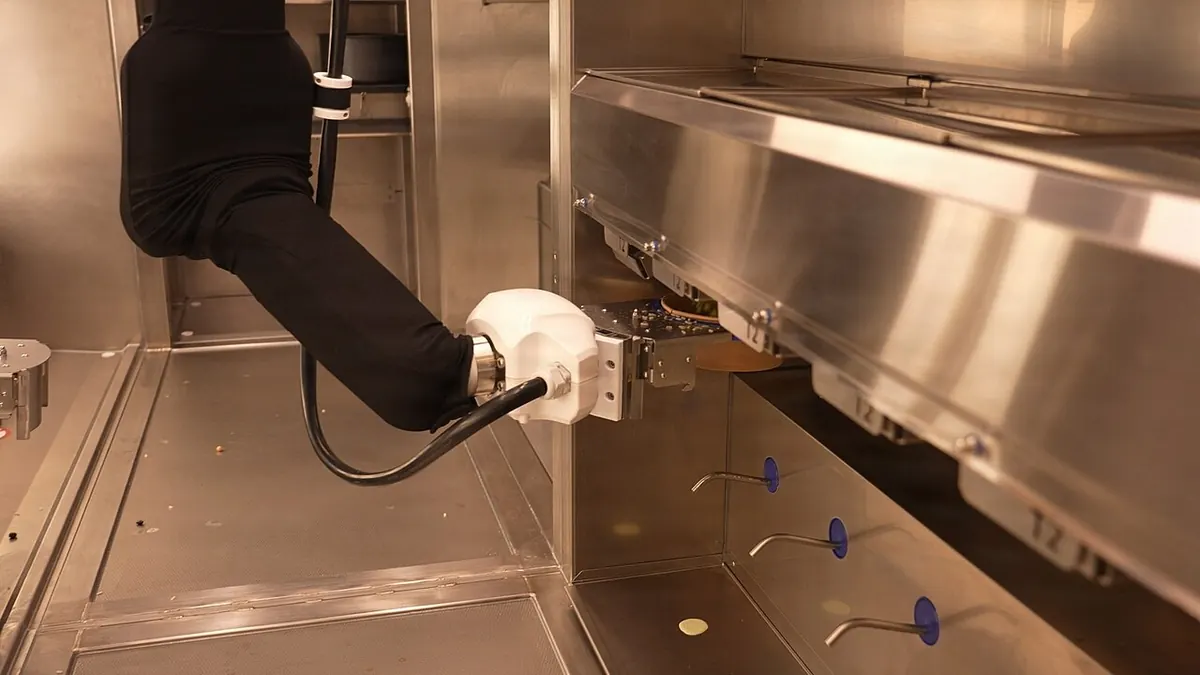
A wok robot is a kitchen machine that stir-fries dishes to a recipe, accurate to the second and the gram. The cook loads chopped ingredients and sauces; the machine does the rest. For a restaurant chain, this means the same taste in every branch, steady speed at rush hour and a cook who works on flavor and the menu instead of standing at the pan all shift.
How it works
The heart of the machine is a rotating bowl, like a wok, with an induction heater underneath. The bowl spins and tilts, ribs or a paddle inside stir the food, and it turns over the same way as when a cook tosses it in the pan. Sensors track the temperature, and the heat changes within seconds: induction heats the metal of the bowl directly, with no open flame.
Oil, sauces and spices come from dispensers — pumps measure out each portion to the gram. The recipe is written as a program: temperature, time, rotation speed and the moment to add each ingredient. The chef tunes the dish once, the way they think it should be — and from then on that recording plays back the same in every branch, even for the hundredth time in a day.
The cook does what the machine cannot do yet: cleans and chops the ingredients, plates the portions, tastes and adjusts the recipe. After each dish, many models rinse the bowl with water on their own and start the next one right away — no one has to stand at the stove washing up. A wok robot runs off a heavy-duty power line, and like any stove in a professional kitchen, it needs an extraction hood above it.
Where it already works
- Xiaocaiyuan, China — the chain bought 3,000 wok robots at ¥50,000 each
- Restaurant chains — the same dish in every branch from one recorded recipe
- Food courts and canteens — a stream of similar hot dishes at rush hour
- Kitchens with Asian menus — fried rice, noodles, meat and vegetables in a wok
What to consider
- The robot fries but does not chop: cleaning, cutting and serving stay with the cooks
- The kitchen needs a heavy-duty power line and an extraction hood — check them before buying
- Prices of $10,000–45,000 are an estimate for the Chinese market; add delivery, certification and service on top
- The dish is only as good as the recipe: the chef writes and fine-tunes the program