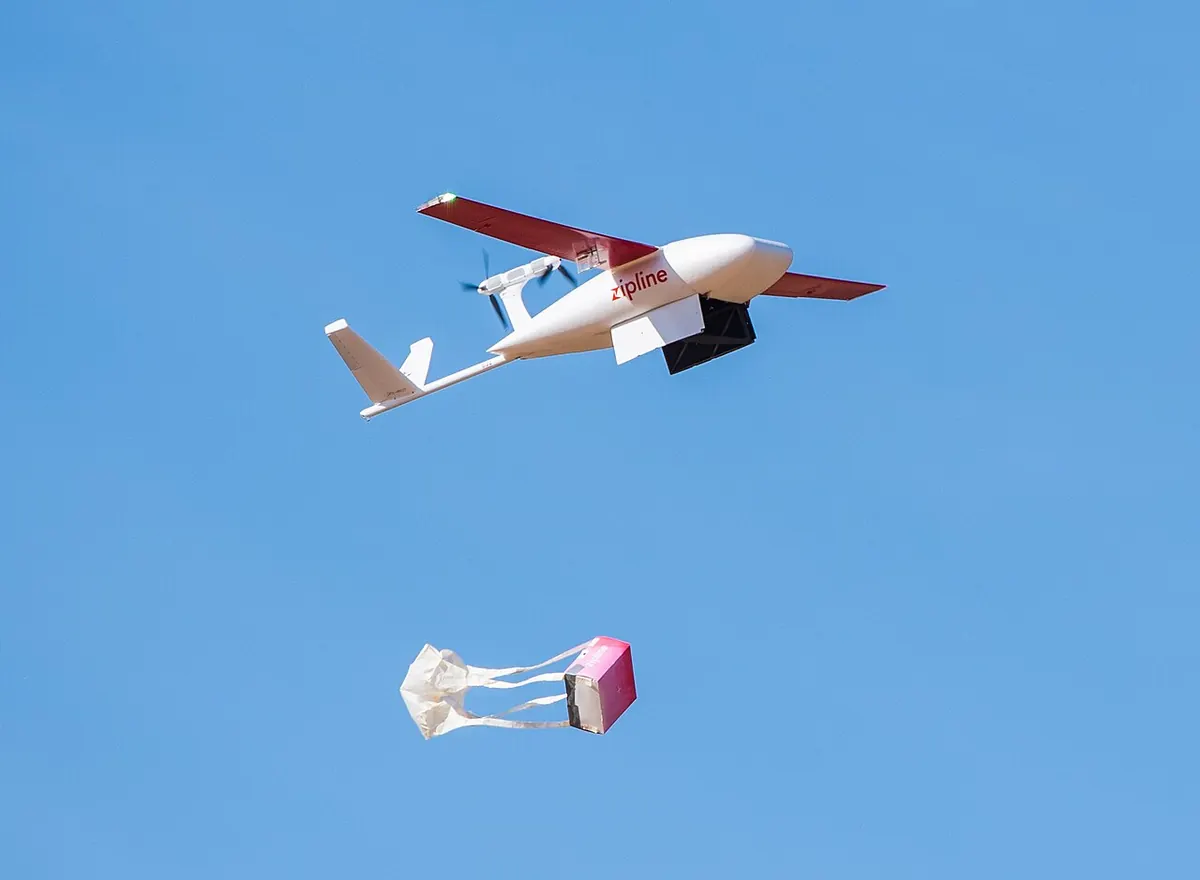
Drone delivery means an order from a store or pharmacy flies in within minutes: the drone hovers over the yard and lowers the bag on a tether. It does not sit in traffic or look for parking, so light, urgent parcels arrive faster than by car. For retail and medicine this is a new speed; for the customer — lunch, medicine or a forgotten little item without a long wait for a courier.
How it works
Delivery drones come in two types. A multicopter stays in the air on several rotors: the onboard computer changes each motor’s speed many times a second and so keeps the aircraft level even in wind. A hybrid takes off vertically and then flies on a wing like an airplane — that way it goes farther and uses less energy. Power comes from lithium batteries, so range and payload are limited: the drone carries a bag, not a fridge.
The route is not arbitrary: the drone flies a pre-approved corridor at a set altitude. Navigation is satellite-based plus inertial sensors that feel every tilt and acceleration. Cameras and rangefinders spot wires, trees and birds, and the software steers around obstacles on its own. Over the delivery point the drone does not land: it hovers and winches the bag down on a tether. The rotors stay high above people’s heads, and the parcel settles gently on the ground.
One operator watches dozens of aircraft: on the screen are the map, battery charge, wind and the status of every parcel. The operator steps in rarely — for example, if the weather turns or an unexpected obstacle appears over a yard. The main barrier is not the technology but the rules of the sky: flights beyond visual line of sight are approved separately, country by country. So the service appears where the regulator and the operator have agreed on corridors — and there, parcels go by the millions.
Where it already works
- Retail: Walmart delivered its millionth drone parcel on 29 May 2026.
- Zipline — over 2 million drone deliveries.
- Medicine: drugs and lab samples between hospitals where the road trip is long.
- Suburbs, islands and mountains, where a courier’s drive is long and the flight takes minutes.
What to consider
- Airspace rules decide everything: each country has its own permits for flights beyond visual line of sight.
- In Russia drone flights are restricted almost everywhere — delivery cannot be launched there yet.
- Wind, downpours and thunderstorms ground flights — you need a backup courier on the ground.
- The load must be light and compact, and the yard needs a spot with no wires or branches above it.