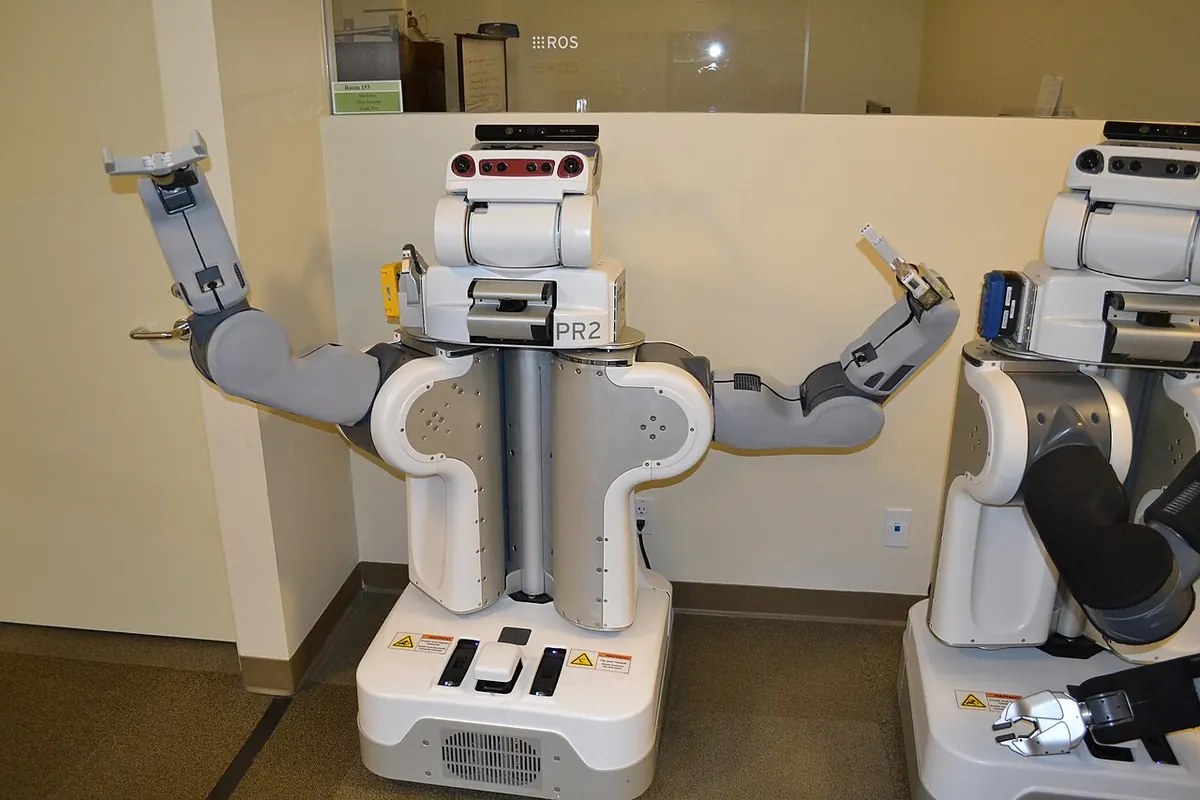
A single “brain” for robots means “vision — language — action” models. The robot receives camera images and a phrase like “clear the dishes” and immediately outputs movements. Each task used to be programmed separately; now one model learns from the data of many robots and transfers a skill to new hands and new homes. For business, this is the road to robots you do not have to reprogram for every little thing.
How it works
Inside is the same architecture as in chatbots, only with a different input and output. The camera image is cut into small pieces and turned into numbers, and so is the phrase. The model looks at everything together and, instead of words, outputs actions: short segments of movement for each joint, many times a second. That is how “pick up the red cup” becomes the path of an arm.
Such a model is trained in three layers. From the internet it learns what things look like and what words mean. From demonstrations — how to move: operators control different robots by hand, and every movement is recorded together with the image. From simulation — what happens when it makes a mistake. The more different robots and places in the data, the better the model handles what it has never seen.
Physical Intelligence, Google DeepMind and NVIDIA train one model on data from many robots. You can see the result in π0.5: the robot cleans up an apartment it sees for the first time. Usually a fast low-level controller runs beneath such a model — it keeps balance and limits force so that a neural network’s mistake does not become dangerous. On 13 Oct 2026, Physical Intelligence opened commercial access to its model via API.
Where it already works
- π0.5 from Physical Intelligence — cleaning an apartment the robot sees for the first time
- Physical Intelligence — commercial API access to the model since 13 Oct 2026
- Google DeepMind — Gemini Robotics models trained on data from many robots
- Sber — the open Green-VLA model under the MIT license for the “Green” humanoid
- AgiBot — its own models that turn camera images into arm movements
What to consider
- Access is an API beta: terms, prices and limits may change
- The model does not replace the body: you need a robot with suitable arms and cameras plus an integration team
- Western cloud models are unavailable from Russia — open models run on your own hardware
- In unfamiliar surroundings the model makes more mistakes: test it on your own task and limit the force