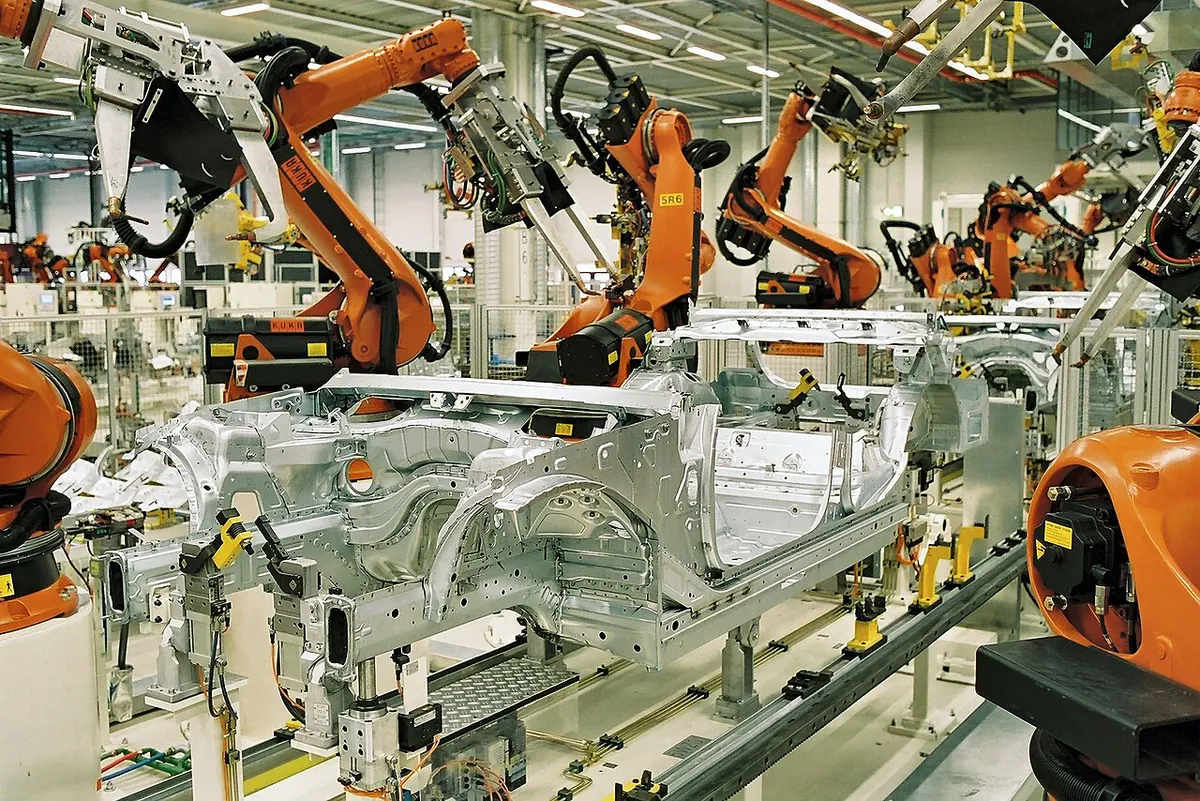
A dark factory is a plant where lines run without people and without lights: only people need light. Robots load blanks, machine tools do the machining, carts take away finished goods, and people come in during the day — to set up, maintain and program. This is not a product but a guidepost for strategy: you get there step by step, and each step — a cobot, a warehouse cart or a quality-control camera — is useful in its own right.
How it works
For a machine tool to work at night without people, it needs a backlog of work. Blanks are fixed on fixture pallets in advance and loaded into a pallet store; a robot or a cart feeds them in turn and takes away the finished parts. The machine changes tools and tracks their wear, a probe inside the machine measures the part during machining, and if there is a deviation the program makes a correction.
Instead of people, the shop floor has sensors, and lighting and walkways are not needed: the shop is built for machines. Spindle vibration, temperature, motor current and air pressure are logged continuously, and changes in them show in advance that a bearing is about to fail. At night, the person on duty, if there is one, watches the screens remotely, and in case of a serious error the line stops safely and waits for morning.
The best-known example is FANUC: since 2001, its robots have been building other robots without people for up to 30 days straight. Xiaomi’s factory in Changping — 11 automated lines for 10 million smartphones a year. What they have in common: the product and the process are designed for the machine in advance — the parts are easy to grip, measure and move, not just to assemble.
Where it already works
- FANUC: robots have been building robots without people for up to 30 days straight since 2001.
- Xiaomi in Changping: 11 automated lines for 10 million smartphones a year.
- Machining: machine tools with a pallet store run the night shift without an operator.
- Electronics assembly, where there are many identical operations and not enough people per shift.
What to consider
- You don’t buy a dark factory whole: you get there area by area — warehouse, machining, quality control.
- Start with the bottleneck where people are short, and count how many shifts it stands idle.
- A lights-out line needs a stable product: with frequent model changes, human flexibility is still cheaper.
- People don’t disappear: setup, service and programming become the main work — you need your own specialists.