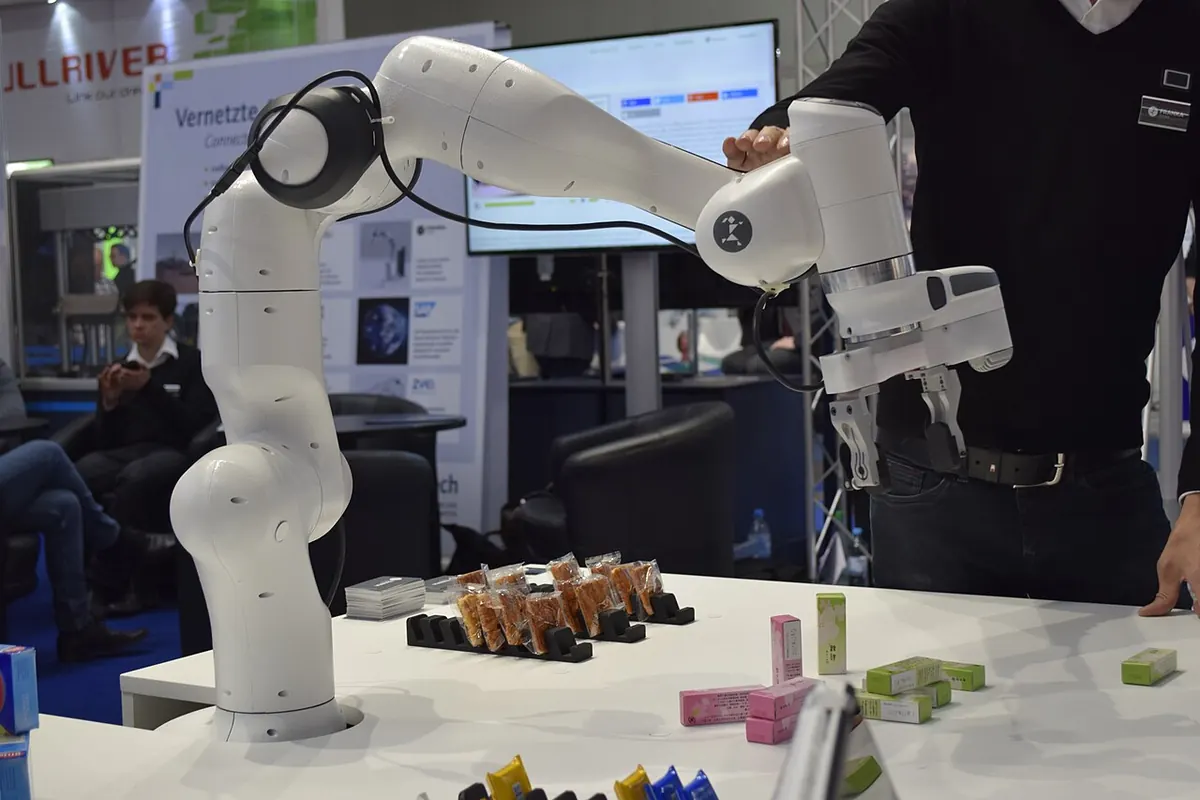
A cobot is a robot arm that works next to people without a safety cage. It stacks boxes on pallets, welds seams and feeds blanks into a machine tool, while people take on setup and supervision. Chinese cobots cost 30–50% less than Western ones, so automation is within reach even for a small plant where every welder counts.
How it works
A cobot arm usually has six joints, each with its own motor, gearbox and angle sensor. Hundreds of times a second, the controller knows the position of every joint and compares the force with the calculated value. If the arm meets something that isn’t in the program — an operator’s elbow or a fallen box — the force rises and the robot stops. Speed and force near people are limited by the settings, so contact stays light.
You program it by hand: the operator presses a button on the robot’s wrist, guides the arm from point to point and saves each position. Then, on a tablet, these points and blocks like “pick”, “wait”, “place” are assembled into a sequence — a bit like building blocks. A simple change of task takes hours, not weeks, and you don’t need a staff robot programmer for it.
The manipulator itself is only an arm. The work is defined by the tooling at its end: a gripper with fingers, vacuum suction cups for boxes, a welding torch or a screwdriver. Around it, a cell is built — a table, part feeding, sensors, sometimes a camera. The key figure when choosing is payload: it includes not just the part but the weight of the tooling. The second is the reach of the arm.
Where it already works
- Palletizing boxes and bags at the end of the line.
- Welding at small plants, where the shortage of welders is most acute.
- Machine tending: the cobot loads a blank and removes the finished part.
- Food and pharmaceutical production: packing, sorting, loading.
What to consider
- Chinese brands like Dobot and JAKA go to Russia; Universal Robots are not supplied there.
- In Russia, an arm costs from ₽1.5 million, a turnkey cell ₽8–30 million, and deployment takes up to 9 months.
- No cage does not mean no risk assessment: a sharp tool or a heavy load calls for guarding.
- In Russia, a 20% cashback from the state on buying and deploying robots runs until 2029 — awarded competitively.