AbsoTech — technology in the Absolute group: the same path to mastery, only in technologyAll of Absolute
Build a request
I-03 · ManufacturingLive

AMR warehouse robots

Autonomous carts bring racks and boxes to the picker: the person does not walk the warehouse, the warehouse comes to them.

$15,000–35,000 per robotplus 30–60% for software and integration; service — $1,000–3,000 a year
RU can be brought inVN can be brought in
TRL 9
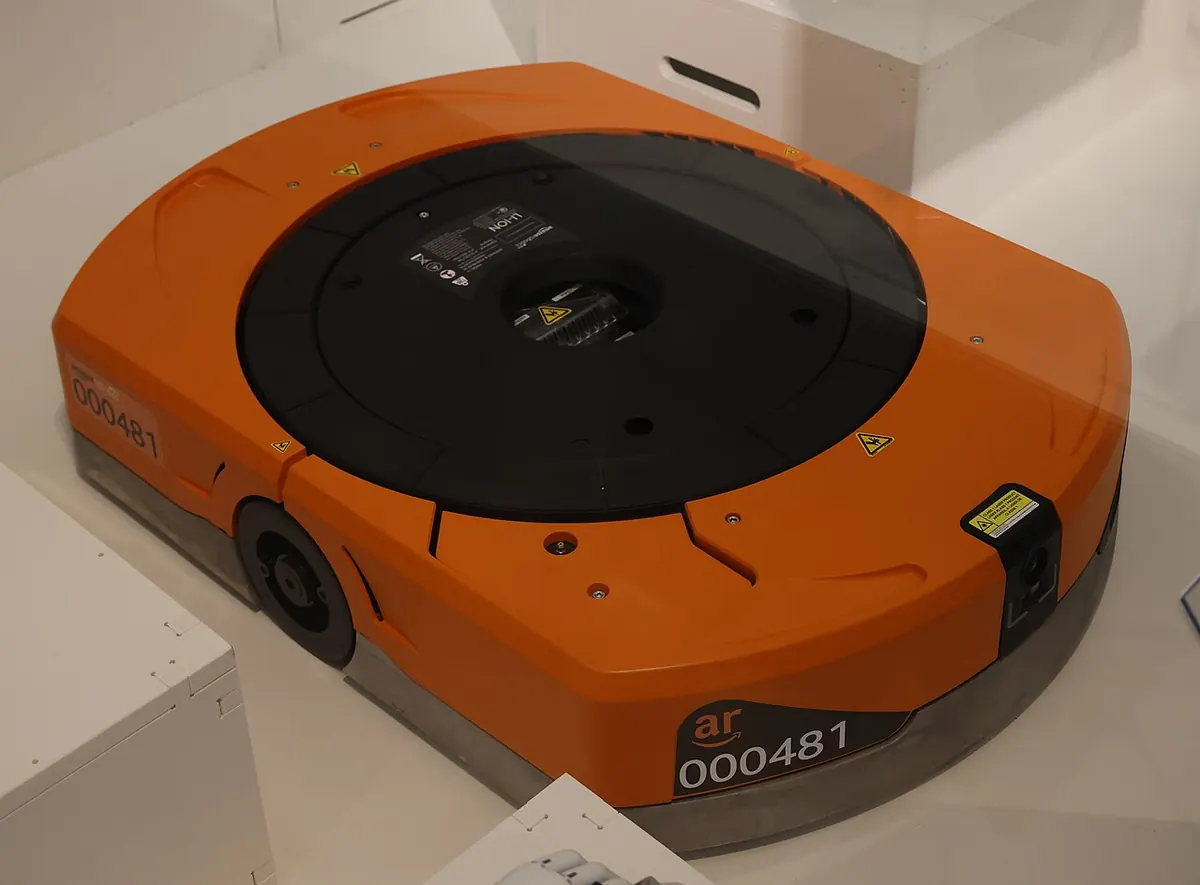
Amazon warehouse robot
In the photo: Amazon warehouse robotPhoto: Geni · CC BY-SA 4.0 · Wikimedia Commons

An AMR warehouse robot is an autonomous cart that finds its own way around the warehouse. The picker no longer walks kilometers between racks each shift: shelves and boxes come to their station. The person takes the item, the robot takes the shelf back, and picking productivity grows several-fold. No rails or magnetic tape on the floor are needed.

How it works

The robot is a low platform on drive wheels with lidar and cameras. The lidar spins a laser beam and draws a map of walls, racks and columns; sometimes code markers are stuck to the floor, and a camera underneath checks the robot’s position against them. One type of robot drives under a rack, lifts it whole and brings it to a person. Another takes boxes off shelves with a gripper. A third — a small sorter — carries a parcel to the right chute.

The brain of the warehouse is the fleet management system. It receives orders from the warehouse software, decides which shelf goes to which picker and hands out jobs to hundreds of robots at once. Routes are planned so that machines don’t meet head-on at intersections, and robots with low batteries go off to charge while the others work. Fast-moving goods are kept closer to the stations, slow movers in the far rows.

At the picker’s station there is a screen and cell lights: the shelf pulls up, a light shows which cell to take from and how many items, and a scanner confirms the product. The person does not walk or search — they just pick and put into the order box. Sorters work in a similar way: the parcel goes onto the robot, a scanner reads the address, and the robot carries it to the chute for its destination.

Where it already works

  • Vietnam: Viettel Post sorts 1.4 million parcels a day with a fleet of about 200 robots.
  • Fulfillment operators and 3PL warehouses that work for marketplaces.
  • Distributors with thousands of SKUs and seasonal order peaks.
  • Factories: in Vietnam, Phenikaa-X builds AMRs for Samsung.

What to consider

  • The budget is not just robots: software and integration add 30–60%, service — $1,000–3,000 a year.
  • You need a level floor without thresholds or potholes: the fleet’s speed and reliability depend on it.
  • Check the link to the warehouse software (WMS): without it, the robots don’t know what to carry.
  • Calculate payback for the peak season and growth, not for an average day.
A joke on the topic

An AMR heads off to charge on its own when its battery runs low. Warehouse staff can do that too — it’s called lunch — but they still have to tell the boss.

Every day, two hundred AMRs pass each other at warehouse intersections without a single honk. The secret is simple: none of them thinks it has the right of way.

The picker no longer looks for the shelf — the shelf looks for the picker and, unlike people, never says, “It was around here somewhere.”

Nearby on the radar

Full radar
I-02 · ManufacturingLive

Cobots

Collaborative robot arms: they work next to people without a cage — palletizing, welding, machine tending.

Dobot Nova 5 — ~$13,800 · JAKA Zu5 — $18,000–22,000 · UR5e — $35,000–45,000price of the arm without tooling; a cell for a specific task costs more
TRL 9
RU can be brought inVN can be brought in
How it works

Force sensors in the joints feel a touch and stop the arm. You program it by guiding the robot’s arm by hand — no programmer needed. Chinese cobots cost 30–50% less than Western ones.

Fact. In 2025, 603,000 industrial robots were installed worldwide, 59% of them in China.

Russia. For Russia — Chinese brands; Western ones have left.

Vietnam. Import duty on industrial robots — 0%.

Sources: IFR World Robotics, 24.09.2026 · Vietnam duty, HS 8479.50

All about the technology: photos, video, details
I-04 · ManufacturingLive

Machine vision on the line

A camera and a neural network check every part on the conveyor: scratches, chips, underfill, skewed labels.

Per projectdepends on line speed and the number of cameras
TRL 9
RU can be brought inVN can be brought in
How it works

The model is trained on images of good and bad products. Then it watches the flow faster than a person, does not tire by the end of the shift and logs defects in a report with a photo.

Fact. Three things to start: a camera, the right light and a server running the model.

All about the technology: photos, video, details

Where to get it

Selection and delivery of AMR robots for warehouses, fulfillment centers and factories on request across Russia: Moscow, Saint Petersburg, Sochi, Krasnaya Polyana, Krasnodar, Yekaterinburg, Kazan, Novosibirsk, Nizhny Novgorod, Rostov-on-Don, Samara, Ufa, Krasnoyarsk, Perm, Voronezh, Chelyabinsk, Tyumen, Vladivostok, Kaliningrad and other cities.

Selection and delivery of AMR robots for warehouses, fulfillment centers and factories on request in Vietnam: Hanoi, Ho Chi Minh City, Da Nang, Nha Trang, Phu Quoc, Hai Phong, Bac Ninh.

Have a task? Build a request

Two minutes — country, task, budget and timing. That is enough to propose a solution.