AbsoTech — technology in the Absolute group: the same path to mastery, only in technologyAll of Absolute
Build a request
E-08 · EnergyLab

Nuclear fusion

The energy of stars on Earth: hydrogen nuclei fuse at a hundred million degrees.

—first plants — not before the end of the decade
a service, not a product
TRL 4
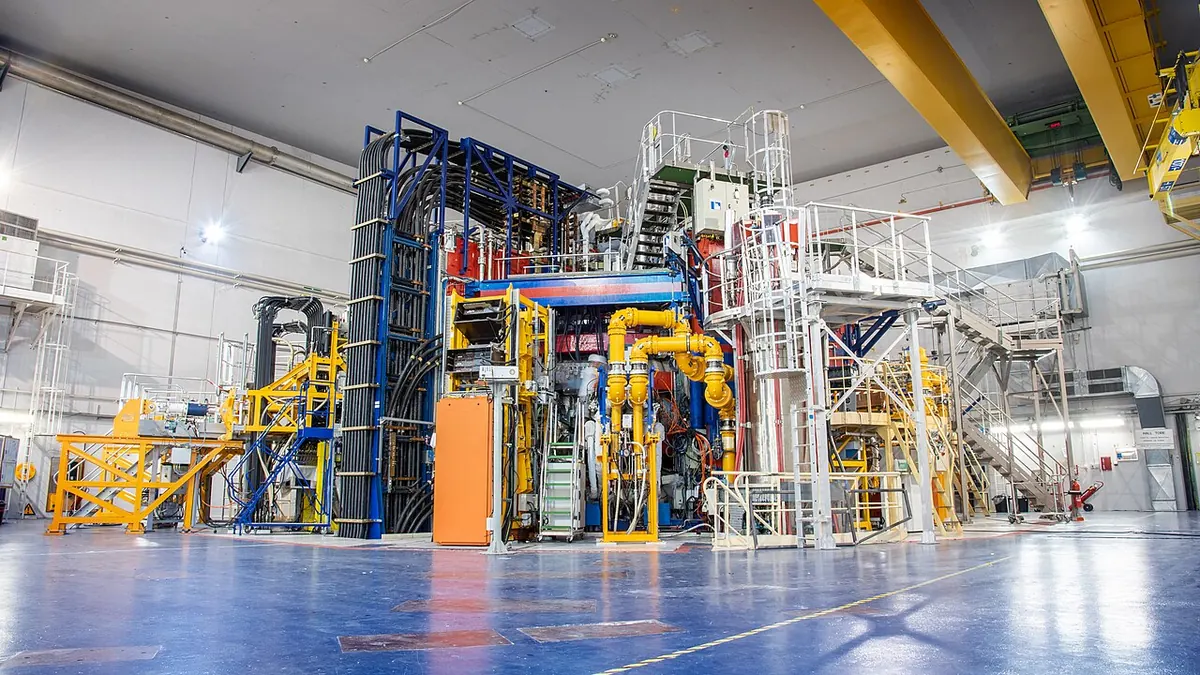
WEST tokamak, France
In the photo: WEST tokamak, FrancePhoto: Christophe Roux / IRFM · CC BY 4.0 · Wikimedia Commons

Nuclear fusion is a way to get energy the way stars do: by fusing light hydrogen nuclei into helium. It needs a tiny amount of fuel, produces no carbon dioxide and no long-lived high-level waste either. For humanity it is a chance at almost inexhaustible energy; for business today it is a strategy horizon: the first plants — not before the end of the decade, and for now it is labs and construction sites.

How it works

Hydrogen nuclei carry the same charge and repel each other. To make them fuse, they have to collide at enormous speed — which means heating the gas to a hundred million degrees. At that temperature matter becomes plasma: electrons are torn away from nuclei. Most often the heavy isotopes of hydrogen are used — deuterium and tritium. When they fuse, they produce a helium nucleus and a fast neutron, and the difference in mass turns into energy by the formula E = mc² — millions of times more than from burning the same amount of fuel.

No wall can withstand hundreds of millions of degrees, so the plasma is held by a magnetic field. A tokamak is a doughnut of magnets: charged particles race around along the field lines and do not touch the walls. The superconducting magnets are cooled almost to absolute zero, while a few meters away burns plasma hotter than the center of the Sun. China’s EAST tokamak held plasma for 1,066 seconds, and at SPARC the magnets are being installed for first plasma in 2027.

The main question is gain: the machine has to give out more energy than it spends on heating and magnets. The energy is carried off by neutrons: they fly out of the plasma, strike the wall — the blanket — and heat it, and from there it is the familiar steam and turbine. In the same blanket, tritium will be bred from lithium, because there is almost none of it in nature. Materials age under the neutron flux, and engineers still have to prove that a plant can run for years, not minutes.

Where it already works

  • China’s EAST tokamak: plasma for 1,066 seconds, January 2025.
  • SPARC: first plasma planned for 2027, energy gain — later.
  • China’s BEST tokamak is being built for 2027.
  • Helion plans to supply fusion energy to Microsoft in 2028 — low confidence.

What to consider

  • There is no fusion electricity on the grid yet: the first plants — not before the end of the decade.
  • Companies’ dates are plans with medium and low confidence, not a delivery schedule.
  • Large volumes of fusion energy on the grid by 2035 — low confidence.
  • For energy today — solar, storage and geothermal; fusion is a strategy horizon.
A joke on the topic

Fusion is the only industry where “keeping a firm grip on things” means “holding them with a magnetic field and never, ever touching them”.

A tokamak is a doughnut that is hotter inside than the center of the Sun, with magnets around it at almost absolute zero. The most complicated kitchen in the world — all so that one day your kettle boils on star power.

AbsoTech’s signature color is the color of hydrogen plasma. So fusion already works here. For now, in the design.

Nearby on the radar

Full radar
E-01 · EnergyLive

Solar and battery for the home

Rooftop panels plus an LFP battery: lights and air conditioning even when the grid is down.

Vietnam: 5 kW — 44–48 million VNDgrid-tied plant without a battery, installer price 2026; with a battery — more
TRL 9
RU can be brought inVN can be brought in
How it works

By day the panels power the home and charge the battery, and a hybrid inverter decides where to draw energy from. In the evening the home runs on the battery, and the surplus goes to the grid — where that is allowed and paid for.

Fact. Chinese TOPCon panels cost about $0.11 per watt ex-factory — cheaper than ever.

Russia. The best fit: the south, dachas without a reliable grid, and backup in case of outages.

Vietnam. Since 26 Jun 2026 (Decree 243), rooftop surplus can be sold — up to 50% of output, including from a battery.

Sources: Decree 243/2026 · TOPCon prices, Jul 2026 · Vietnam installer prices

All about the technology: photos, video, details
E-02 · EnergyLive

Industrial battery storage (BESS)

Battery containers for factories, hotels and grids: they shave peaks, hold a reserve and store cheap energy.

Per projectdepends on capacity and use case
TRL 9
RU can be brought inVN can be brought in
How it works

The system charges at night or from solar and releases energy at peak hours, when it costs more — or during an outage. Software that tracks the tariff and the load runs it all.

Fact. In 2025, 112 GW of storage was deployed worldwide (+48%); 54% of it in China.

Vietnam. Vietnam’s power development plan: 10–16.3 GW of storage by 2030, against less than 100 MW at the start of 2025.

Sources: BNEF via ESS News · PDP8 (KPMG)

All about the technology: photos, video, details
E-03 · EnergyPilots

Sodium-ion batteries

Batteries made with sodium instead of lithium: cheaper raw materials and almost no fear of frost.

So far in cars and storage systemsfew retail modules
TRL 8
RU with caveatsVN with caveats
How it works

Sodium comes from ordinary salt, and there is thousands of times more of it than lithium. CATL Naxtra holds 175 Wh per kg and keeps over 90% of its capacity at −40 °C — for a Russian winter, that is the deciding argument.

Fact. The first production car on sodium — Changan Nevo A06 (February 2026).

Source: CnEVPost, 05.02.2026

All about the technology: photos, video, details
Have a task? Build a request

Two minutes — country, task, budget and timing. That is enough to propose a solution.