AbsoTech — technology in the Absolute group: the same path to mastery, only in technologyAll of Absolute
Build a request
E-05 · EnergyLab

Perovskite tandems

A second layer of perovskite on top of silicon catches the part of the light that silicon loses.

—no mass-market panels yet
RU not yetVN not yet
TRL 5
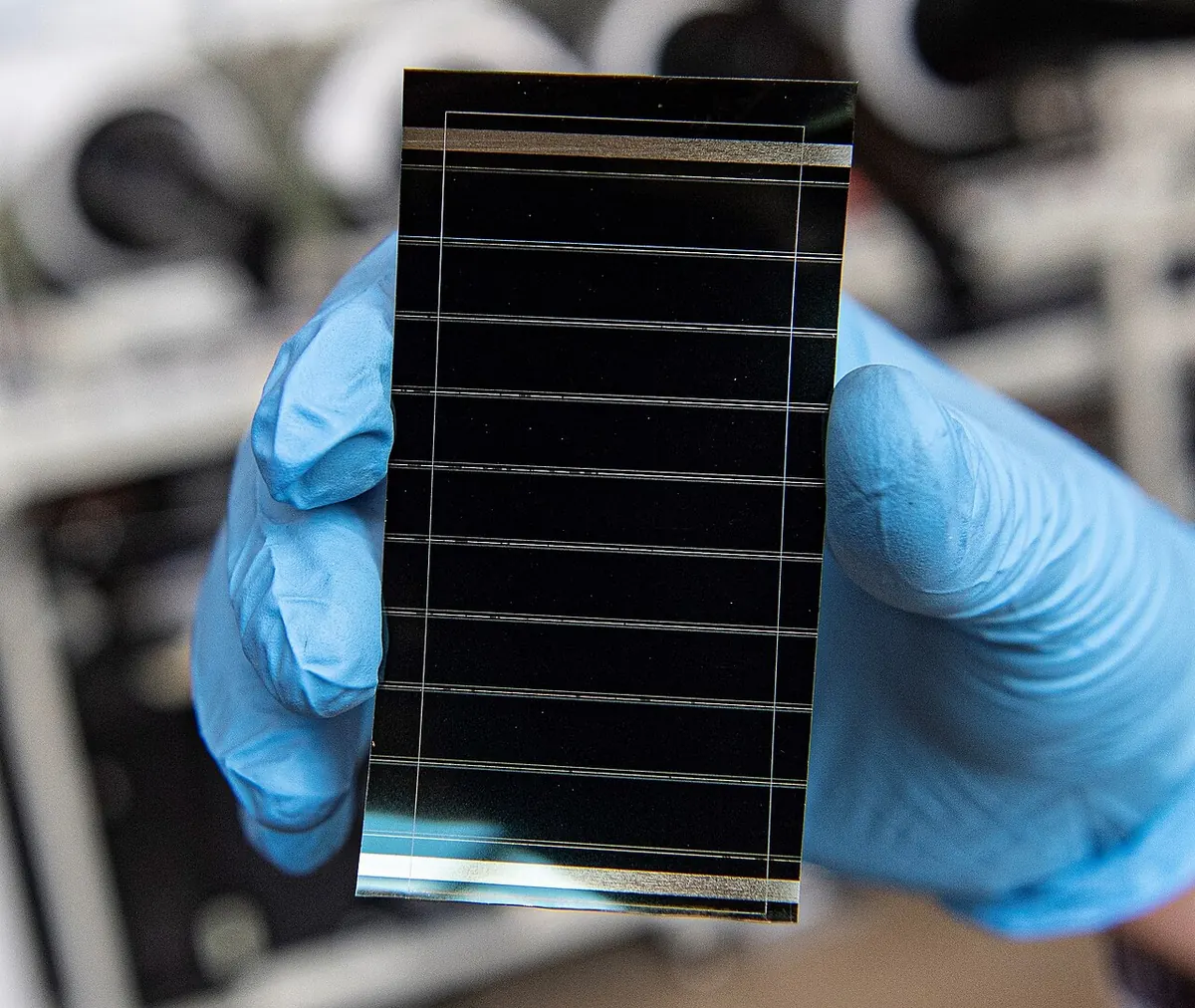
Perovskite solar cell in an NREL lab
In the photo: Perovskite solar cell in an NREL labPhoto: Dennis Schroeder / National Renewable Energy Laboratory · Public domain · Wikimedia Commons

A perovskite tandem is a two-story solar cell: a thin layer of perovskite on top, familiar silicon below. Each story catches its own part of the solar spectrum, and together they turn more light into electricity than silicon alone. For homes and business these are future panels that will give noticeably more energy from the same roof. Today these are lab records, not a product.

How it works

Sunlight is a mix of photons with different energies: blue ones carry a lot, red and infrared ones less. Silicon absorbs almost all visible light, but from each “rich” blue photon it takes exactly as much energy as it needs to free one electron, and the rest turns into heat. That is why silicon has a physical ceiling, and an ordinary panel turns 22–24% of sunlight into electricity.

Perovskite is a crystal with the same lattice as the mineral perovskite, named after the mineralogist Lev Perovski. For cells it is applied from a solution of lead, iodine and bromine compounds at a low temperature — in a layer many times thinner than a hair. The composition is tuned so that the top layer takes the blue and green part of the spectrum with smaller losses and lets red and infrared light through, down to the silicon. The two stories share the sun, and LONGi’s record for such a cell is 35.5%.

The main difficulty is durability. Silicon stands on a roof for years in rain and heat, while perovskite is sensitive to moisture, heat and ultraviolet light: the crystal slowly breaks down, and the cell loses power. Scientists are working out compositions, protective layers and sealed packaging, and learning to coat large areas evenly instead of tiny lab samples. For now, records are set on small cells, and there are no mass-market panels.

Where it already works

  • Manufacturers’ labs: LONGi’s tandem cell record — 35.5%, July 2026.
  • Durability testing of samples under sun, moisture and heat.
  • Research into light, flexible cells for roofs where a heavy panel will not do.

What to consider

  • There are no mass-market panels: check any “perovskite” panels on sale today especially strictly.
  • The efficiency record is for a small lab cell; a large panel always scores lower.
  • Service life on a roof has not yet been proven by years of operation — that is the main open question.
  • If you need a system now, go with TOPCon: these panels are cheaper than ever.
A joke on the topic

Solar power has finally caught up with what grandmothers always knew: two layers are better than one.

Perovskite has one weakness: it is afraid of moisture. In the rainy season it would act just like me — stay home and wait for the weather to clear.

In the lab, perovskite sets records like a kid on the pull-up bar at home. The hardest part is still ahead: going out on the roof and standing there for a couple of decades without a tantrum.

Nearby on the radar

Full radar
E-01 · EnergyLive

Solar and battery for the home

Rooftop panels plus an LFP battery: lights and air conditioning even when the grid is down.

Vietnam: 5 kW — 44–48 million VNDgrid-tied plant without a battery, installer price 2026; with a battery — more
TRL 9
RU can be brought inVN can be brought in
How it works

By day the panels power the home and charge the battery, and a hybrid inverter decides where to draw energy from. In the evening the home runs on the battery, and the surplus goes to the grid — where that is allowed and paid for.

Fact. Chinese TOPCon panels cost about $0.11 per watt ex-factory — cheaper than ever.

Russia. The best fit: the south, dachas without a reliable grid, and backup in case of outages.

Vietnam. Since 26 Jun 2026 (Decree 243), rooftop surplus can be sold — up to 50% of output, including from a battery.

Sources: Decree 243/2026 · TOPCon prices, Jul 2026 · Vietnam installer prices

All about the technology: photos, video, details
E-02 · EnergyLive

Industrial battery storage (BESS)

Battery containers for factories, hotels and grids: they shave peaks, hold a reserve and store cheap energy.

Per projectdepends on capacity and use case
TRL 9
RU can be brought inVN can be brought in
How it works

The system charges at night or from solar and releases energy at peak hours, when it costs more — or during an outage. Software that tracks the tariff and the load runs it all.

Fact. In 2025, 112 GW of storage was deployed worldwide (+48%); 54% of it in China.

Vietnam. Vietnam’s power development plan: 10–16.3 GW of storage by 2030, against less than 100 MW at the start of 2025.

Sources: BNEF via ESS News · PDP8 (KPMG)

All about the technology: photos, video, details
E-03 · EnergyPilots

Sodium-ion batteries

Batteries made with sodium instead of lithium: cheaper raw materials and almost no fear of frost.

So far in cars and storage systemsfew retail modules
TRL 8
RU with caveatsVN with caveats
How it works

Sodium comes from ordinary salt, and there is thousands of times more of it than lithium. CATL Naxtra holds 175 Wh per kg and keeps over 90% of its capacity at −40 °C — for a Russian winter, that is the deciding argument.

Fact. The first production car on sodium — Changan Nevo A06 (February 2026).

Source: CnEVPost, 05.02.2026

All about the technology: photos, video, details
Have a task? Build a request

Two minutes — country, task, budget and timing. That is enough to propose a solution.