AbsoTech — technology in the Absolute group: the same path to mastery, only in technologyAll of Absolute
Build a request
E-07 · EnergyPilots

Small nuclear reactors

Reactors of 50–300 MW that are assembled in a factory and delivered as ready modules.

—state-run energy
a service, not a product
TRL 7
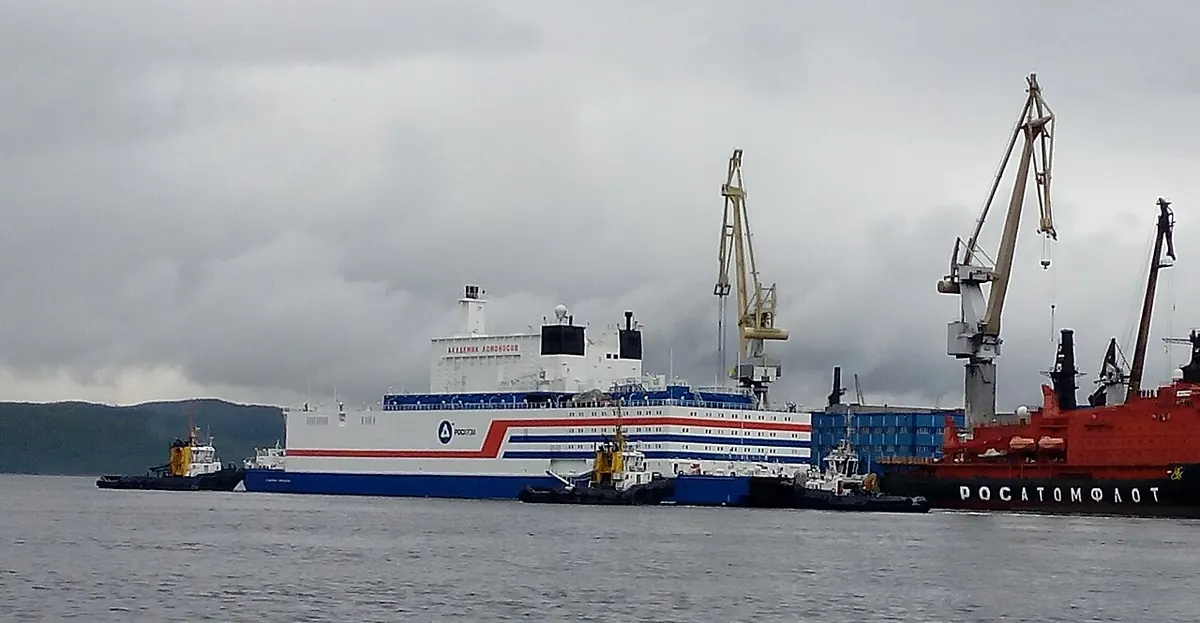
Akademik Lomonosov floating nuclear plant under tow in Murmansk
In the photo: Akademik Lomonosov floating nuclear plant under tow in MurmanskPhoto: Grumbler eburg · CC BY-SA 4.0 · Wikimedia Commons

A small modular reactor is a nuclear plant of 50–300 MW that is assembled in a factory and delivered as ready modules. Such a reactor gives light and heat to a village, mine or island where running a power line and shipping in fuel is expensive. The energy flows around the clock for years without new deliveries, and factory assembly is meant to make construction faster and more predictable than for large nuclear plants.

How it works

At its core is uranium fission. A uranium-235 nucleus catches a neutron, splits into two fragments and throws out two or three more neutrons, which split neighboring nuclei. The fragments fly apart at enormous speed and heat the fuel, and the fuel heats the water around it. The pace of the chain reaction is set by rods that absorb excess neutrons: rods deeper — the reaction is weaker; higher — stronger. After that, it is all as in an ordinary plant: heat, steam, turbine, generator.

Small size changes the main thing — cooling. After shutdown the fuel keeps giving off residual heat for a long time, and that heat has to go somewhere. The smaller the core, the easier it is to remove it without pumps: heated water rises, cooled water sinks, and the circulation runs by itself, on physics alone. In many designs the steam generators are built right into the reactor vessel, so there are fewer pipes that could leak.

Factory assembly is closer to shipbuilding than to construction: a module is made in a workshop, tested and shipped to the site by water or by road. Russian reactors of this class grew out of icebreaker reactors. The floating plant Akademik Lomonosov has been operating since 2020, and a land-based small nuclear plant with a RITM-200N reactor is being built in Yakutia — launch is planned for 2028. China’s Linglong One is going through hot testing before connecting to the grid.

Where it already works

  • The floating plant Akademik Lomonosov has supplied energy to Chukotka in Russia’s Far East since 2020.
  • Yakutia: a land-based small nuclear plant with a RITM-200N reactor, launch planned for 2028.
  • China: Linglong One in hot testing, grid connection expected in 2026.
  • Remote villages, mines and islands where running power lines and shipping in fuel is expensive.

What to consider

  • This is state-run energy: projects go through state companies, licenses and intergovernmental agreements.
  • The first units cost more than series ones — the economics work out when reactors are built in series.
  • You need a consumer for decades: a plant takes years to build and runs for a very long time.
  • Handling fuel and waste is part of the project from day one.
A joke on the topic

A small reactor is a rare case where a nuclear plant arrives like a wardrobe from a store: assembled at the factory, delivered, plugged in. The instruction manual is a bit thicker, though.

A reactor of icebreaker descent feels on land like a sailor on vacation: everything is familiar, only the deck does not rock.

A diesel generator asks for fuel every week; a small reactor, once every few years. The fuel truck driver is the happiest of all: for the first time, a summer vacation.

Nearby on the radar

Full radar
E-01 · EnergyLive

Solar and battery for the home

Rooftop panels plus an LFP battery: lights and air conditioning even when the grid is down.

Vietnam: 5 kW — 44–48 million VNDgrid-tied plant without a battery, installer price 2026; with a battery — more
TRL 9
RU can be brought inVN can be brought in
How it works

By day the panels power the home and charge the battery, and a hybrid inverter decides where to draw energy from. In the evening the home runs on the battery, and the surplus goes to the grid — where that is allowed and paid for.

Fact. Chinese TOPCon panels cost about $0.11 per watt ex-factory — cheaper than ever.

Russia. The best fit: the south, dachas without a reliable grid, and backup in case of outages.

Vietnam. Since 26 Jun 2026 (Decree 243), rooftop surplus can be sold — up to 50% of output, including from a battery.

Sources: Decree 243/2026 · TOPCon prices, Jul 2026 · Vietnam installer prices

All about the technology: photos, video, details
E-02 · EnergyLive

Industrial battery storage (BESS)

Battery containers for factories, hotels and grids: they shave peaks, hold a reserve and store cheap energy.

Per projectdepends on capacity and use case
TRL 9
RU can be brought inVN can be brought in
How it works

The system charges at night or from solar and releases energy at peak hours, when it costs more — or during an outage. Software that tracks the tariff and the load runs it all.

Fact. In 2025, 112 GW of storage was deployed worldwide (+48%); 54% of it in China.

Vietnam. Vietnam’s power development plan: 10–16.3 GW of storage by 2030, against less than 100 MW at the start of 2025.

Sources: BNEF via ESS News · PDP8 (KPMG)

All about the technology: photos, video, details
E-03 · EnergyPilots

Sodium-ion batteries

Batteries made with sodium instead of lithium: cheaper raw materials and almost no fear of frost.

So far in cars and storage systemsfew retail modules
TRL 8
RU with caveatsVN with caveats
How it works

Sodium comes from ordinary salt, and there is thousands of times more of it than lithium. CATL Naxtra holds 175 Wh per kg and keeps over 90% of its capacity at −40 °C — for a Russian winter, that is the deciding argument.

Fact. The first production car on sodium — Changan Nevo A06 (February 2026).

Source: CnEVPost, 05.02.2026

All about the technology: photos, video, details
Have a task? Build a request

Two minutes — country, task, budget and timing. That is enough to propose a solution.